
Types of Ultrasound
Ultrasound refers to sound waves with frequencies higher than the upper limit of human hearing, typically above 20 kHz. Although ultrasound is often associated with medical imaging, it is also widely used in industrial manufacturing, laboratory processing, sensing, cleaning, welding, cutting, and material treatment.
In most ultrasonic systems, a piezoelectric transducer is the core component. It converts electrical energy into high-frequency mechanical vibration, or converts returning sound waves back into electrical signals. By selecting the right frequency, power level, transducer structure, and horn design, ultrasound can be used for very different applications, from precise distance measurement to high-intensity liquid processing.

How Ultrasound Is Commonly Classified
Ultrasound can be classified in several ways, including by frequency, power level, transmission medium, and application. For industrial users, the most practical distinction is often between low-power ultrasound and high-power ultrasound.
Low-power ultrasound is mainly used for detection, measurement, and signal transmission. The ultrasonic energy is controlled so that it does not significantly change the material being tested. Typical examples include ultrasonic sensors, level measurement, flow measurement, thickness testing, and non-destructive testing.
High-power ultrasound is used to actively process materials. In these applications, ultrasonic vibration is strong enough to create mechanical effects such as cavitation, frictional heating, cutting, welding, dispersion, emulsification, or particle deagglomeration.
1. Ultrasonic Sensing and Measurement
Ultrasonic sensors use high-frequency sound waves to detect objects, measure distance, or monitor liquid levels. A piezoelectric transducer emits an ultrasonic pulse and receives the echo reflected from a target. The sensor calculates the distance based on the time it takes for the echo to return.
This type of ultrasound is commonly used in industrial automation, packaging equipment, robotics, level monitoring, and object detection. Because ultrasonic sensing is based on sound rather than light, it can detect transparent, reflective, colored, or dark objects more reliably than many optical sensors.
2. Ultrasonic Cleaning
Ultrasonic cleaning uses high-frequency sound waves in a liquid bath to generate cavitation. Cavitation occurs when microscopic bubbles form and collapse rapidly, creating powerful local cleaning action on the surface of immersed parts.
This process is effective for removing oil, dust, polishing compounds, metal particles, and other contaminants from complex surfaces. It is especially useful for precision parts with blind holes, grooves, threads, small gaps, or internal structures that are difficult to clean manually.
Common applications include cleaning mechanical components, electronic parts, medical instruments, optical parts, jewelry, molds, and precision hardware.
3. Ultrasonic Welding
Ultrasonic welding uses high-frequency mechanical vibration to join thermoplastic parts or certain metal components. In plastic welding, ultrasonic energy is concentrated at the joint interface, where frictional heat softens and melts the material. After cooling under pressure, the parts form a strong bond.
This method is fast, clean, and highly repeatable. It does not require glue, solvent, screws, or additional consumables. Ultrasonic welding is widely used in automotive parts, medical devices, electronics, packaging, filters, and plastic assemblies.
For reliable welding results, the ultrasonic generator, transducer, booster, horn, fixture, material selection, and joint design must work together as a complete system.
4. Ultrasonic Cutting
Ultrasonic cutting applies high-frequency vibration to a blade or cutting tool. The vibration reduces friction between the blade and the material, allowing cleaner cutting with less force, less deformation, and reduced material sticking.
Ultrasonic cutting is suitable for rubber, plastic, textiles, non-woven materials, food products, composite materials, honeycomb structures, and other materials that are difficult to cut cleanly with conventional methods.
Compared with traditional cutting, ultrasonic cutting can improve edge quality, reduce debris, lower cutting resistance, and support automated production.
5. Ultrasonic Homogenization and Sonication
Ultrasonic homogenizers, also known as sonicators, use high-intensity ultrasonic vibration in liquids. The ultrasonic probe transfers energy directly into the sample, generating cavitation and strong micro-mixing effects.
This technology is widely used for sample preparation, cell disruption, emulsification, dispersion, nanoparticle processing, extraction, degassing, and acceleration of chemical reactions.
In laboratory and industrial applications, ultrasonic homogenization can help reduce particle size, break agglomerates, improve mixing efficiency, and create stable emulsions or suspensions.
6. Ultrasonic Non-Destructive Testing
Ultrasonic non-destructive testing, often called ultrasonic NDT or ultrasonic inspection, uses sound waves to detect internal defects, measure thickness, or evaluate material integrity without damaging the part.
An ultrasonic transducer sends sound waves into a material. Reflections from internal cracks, voids, inclusions, or the back wall of the part are analyzed to evaluate structure and quality.
Ultrasonic testing is commonly used in metal inspection, weld inspection, aerospace, pressure vessels, pipelines, castings, forgings, and quality control.
7. Medical and Diagnostic Ultrasound
Medical ultrasound uses high-frequency, low-power sound waves to create images of the human body. In this field, safety, resolution, penetration depth, and signal processing are critical.
Although medical ultrasound and industrial ultrasound both rely on piezoelectric transducers, their design goals are very different. Medical systems focus on imaging and diagnosis, while industrial high-power systems focus on energy transfer, vibration amplitude, mechanical performance, and process reliability.
Choosing the Right Type of Ultrasonic System
The right ultrasonic solution depends on the application. Important selection factors include:
- Operating frequency
- Required power and amplitude
- Transducer type and piezo ceramic performance
- Working medium, such as air, liquid, or solid material
- Horn or probe design
- Material properties
- Continuous or intermittent operation
- Required precision, reliability, and production speed
For example, ultrasonic sensing usually requires stable signal transmission and sensitive echo detection. Ultrasonic welding requires efficient energy concentration at the joint. Ultrasonic homogenization requires strong cavitation in liquid. Ultrasonic cutting requires a durable vibrating blade with controlled amplitude.
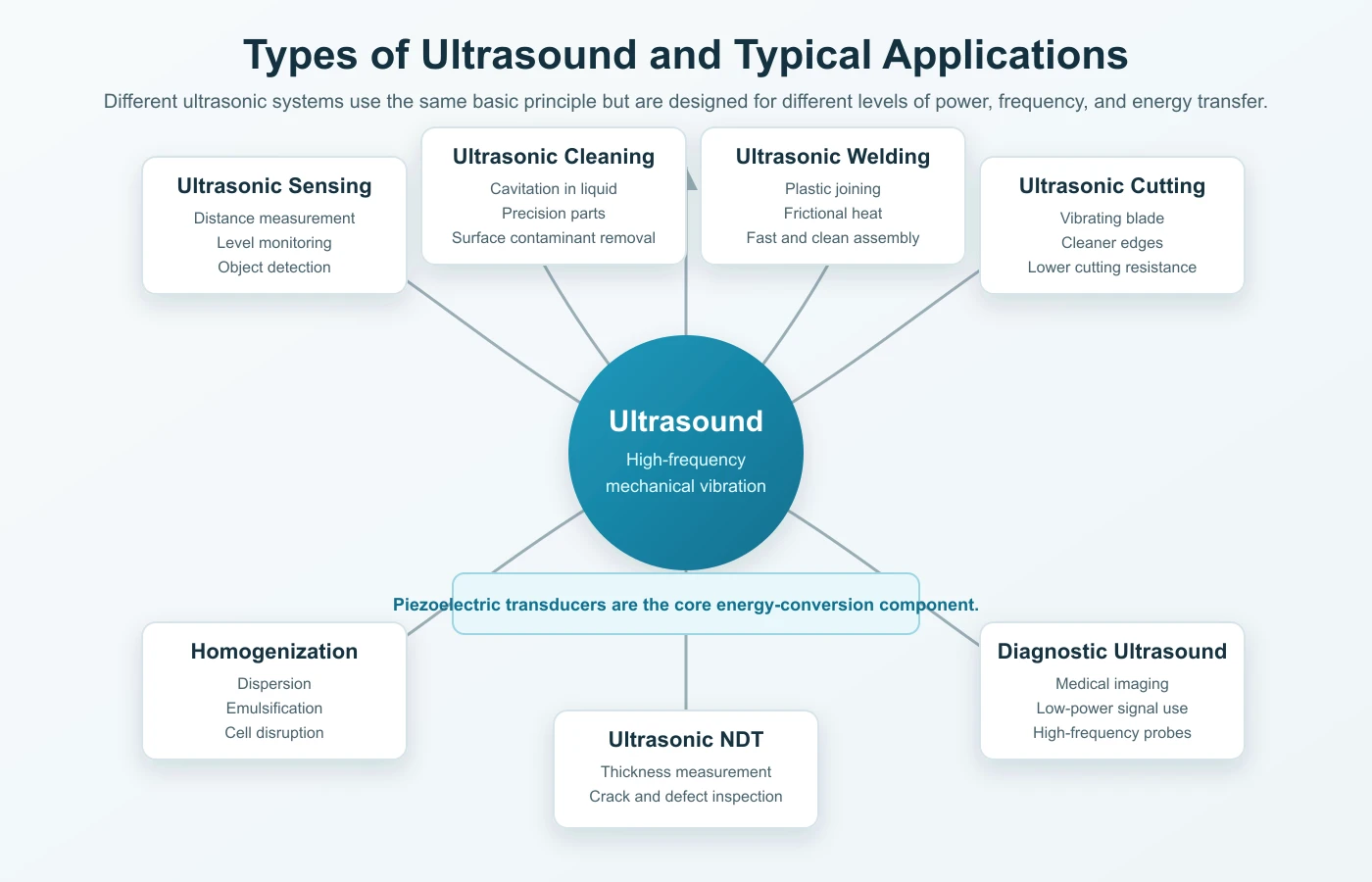
Ultrasound is not a single technology, but a broad family of solutions based on high-frequency mechanical vibration. Depending on the frequency, power, and system design, ultrasound can be used to detect, measure, clean, weld, cut, disperse, homogenize, inspect, and process materials.
For industrial applications, the performance of the piezoelectric transducer, ultrasonic generator, horn, and tooling directly affects the final result. By understanding the main types of ultrasound and their working principles, manufacturers can select a more suitable ultrasonic solution for their process and achieve better efficiency, consistency, and product quality.

Leave A Comment