
What Is the Piezoelectric Effect?
Direct Piezoelectric Effect
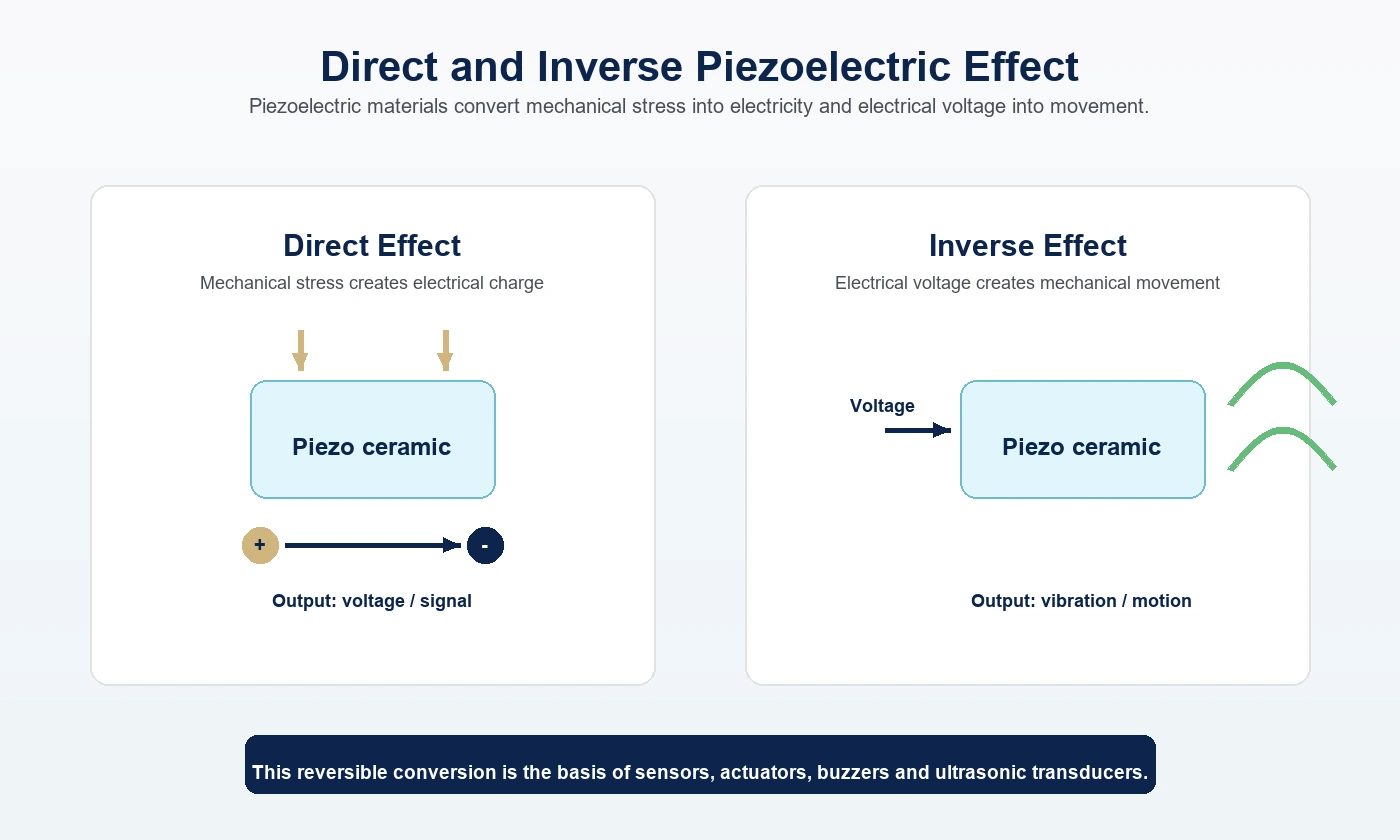
The direct piezoelectric effect occurs when a piezoelectric material generates an electrical charge in response to mechanical stress.
When pressure, vibration, impact, compression, or bending acts on the material, the positive and negative charge centers inside the crystal structure shift slightly. This shift creates electrical polarization. As a result, opposite charges appear on different surfaces of the material, and a voltage can be measured across the electrodes.
This is why piezoelectric materials are widely used in sensor applications. A mechanical input can be converted into an electrical output signal that can be measured, processed, and used for control or monitoring.
Typical direct-effect applications include:
- Pressure sensors
- Force sensors
- Acceleration sensors
- Vibration sensors
- Acoustic pick-ups
- Ultrasonic receivers
- Knock sensors
- Structural health monitoring devices
In these applications, the piezoelectric material acts as a bridge between the mechanical world and electronic measurement systems.
Inverse Piezoelectric Effect
The inverse piezoelectric effect works in the opposite direction. When an electrical voltage is applied to a piezoelectric material, the material changes shape. It may expand, contract, bend, or vibrate depending on the electrical signal, material structure, and electrode design.
This reversible behavior makes piezoelectric materials highly valuable in actuation and ultrasonic energy conversion. By applying a high-frequency alternating voltage, a piezoelectric ceramic can vibrate at ultrasonic frequency and generate mechanical energy.
Typical inverse-effect applications include:
- Ultrasonic transducers
- Ultrasonic cleaning systems
- Ultrasonic welding transducers
- Ultrasonic homogenizers and sonicators
- Piezo buzzers and sounders
- Precision actuators
- Micro-positioning devices
- Optical alignment systems
In ultrasonic equipment, the inverse piezoelectric effect is used to convert electrical power from the generator into high-frequency mechanical vibration. This vibration is then transmitted into a horn, probe, cleaning tank, liquid, or other working medium.
Why the Effect Is Reversible
One of the most useful characteristics of the piezoelectric effect is that it is reversible. A material that generates charge under mechanical stress can also produce mechanical deformation when an electrical field is applied.
This reversibility is possible because of the internal crystal structure of piezoelectric materials. In suitable materials, the positive and negative charge centers are arranged in a way that allows mechanical and electrical states to influence each other.
When mechanical stress is applied, the charge distribution changes and produces voltage. When voltage is applied, the electric field changes the internal balance of the material and produces movement.
This two-way conversion is what makes piezoelectric ceramics so useful for both sensing and driving functions.
Piezoelectric Ceramics and PZT Materials
Many natural and engineered materials can show piezoelectric behavior, but piezoelectric ceramics are widely used because they can provide strong performance, stable properties, and flexible manufacturing options.
One of the most common piezoelectric ceramic families is PZT, or lead zirconate titanate. PZT ceramics can be formulated for different performance targets. Some are designed for high sensitivity, while others are designed for high power, low loss, and stable resonance operation.
Depending on the application, piezo ceramic components may be manufactured as:
- Discs
- Rings
- Plates
- Tubes
- Stacks
- Custom-shaped elements
This design flexibility allows piezoelectric ceramics to be used in compact sensors, high-power ultrasonic transducers, precision actuators, and many other devices.
Applications of the Piezoelectric Effect
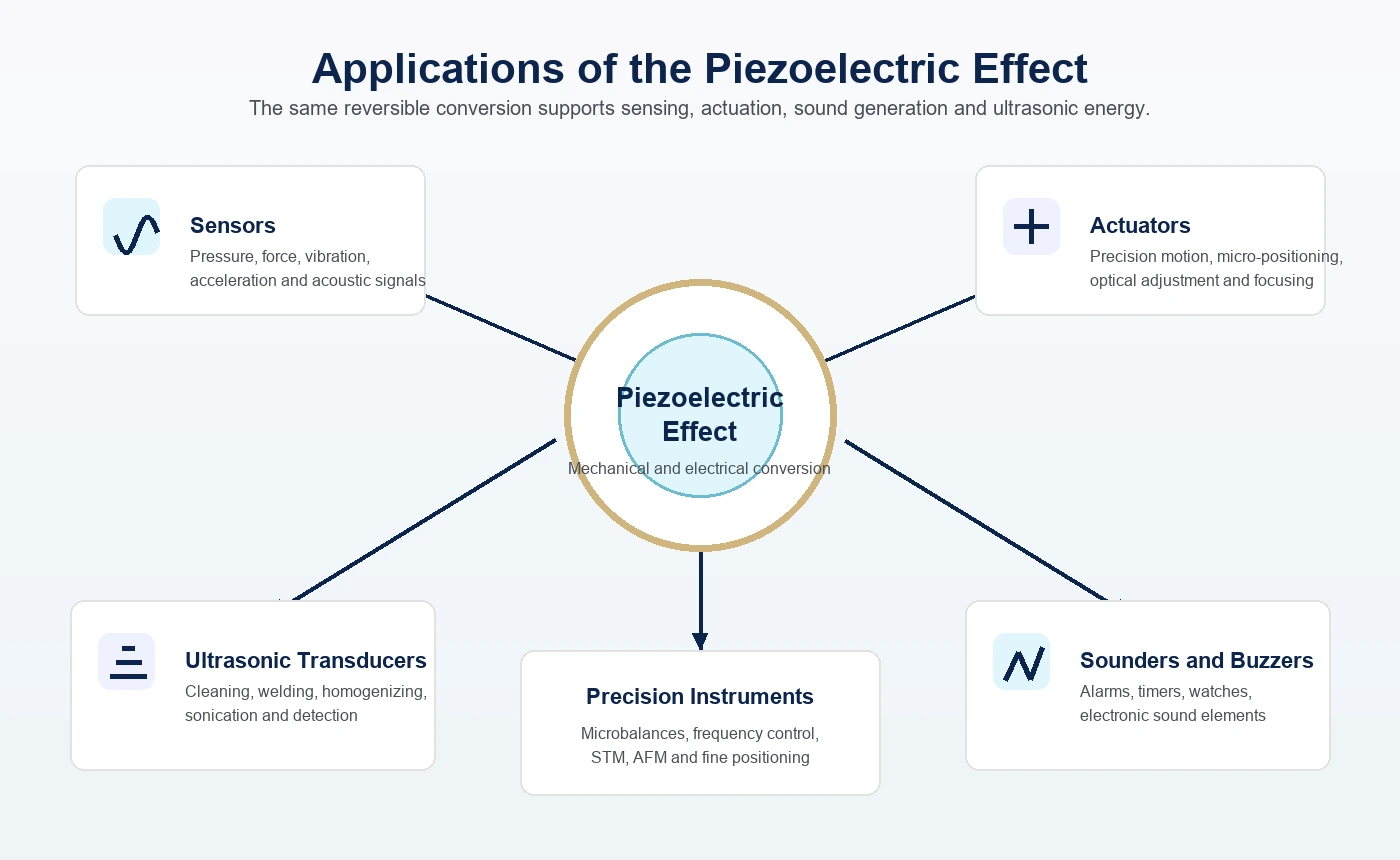
The piezoelectric effect is used in a wide range of technologies, from everyday products to advanced industrial systems.
In sound generation, piezoelectric ceramics are used in buzzers, alarms, watches, timers, and electronic sounders. The ceramic vibrates when voltage is applied, generating audible sound.
In sensing, piezoelectric materials detect force, pressure, vibration, acceleration, shock, and acoustic signals. These sensors are used in automotive systems, industrial monitoring, civil engineering, medical instruments, and precision measurement.
In ultrasonic systems, piezoelectric ceramics are the active core of ultrasonic transducers. They are used in ultrasonic cleaning, welding, cutting, homogenization, dispersion, emulsification, extraction, flow measurement, distance measurement, and non-destructive testing.
In precision instruments, the piezoelectric effect is used for micro-positioning, fine focusing of optical assemblies, frequency control, microbalances, and scanning probe microscopy such as STM and AFM.
Even simple devices such as piezoelectric igniters use the direct piezoelectric effect to generate a high voltage from mechanical pressure.
Why It Matters for Ultrasonic Transducers
For ultrasonic transducers, the piezoelectric effect is the key mechanism behind energy conversion.
The ultrasonic generator supplies an alternating electrical signal. The piezo ceramic element responds through the inverse piezoelectric effect and vibrates at ultrasonic frequency. This vibration is transferred through the transducer structure and delivered into a tool, horn, probe, cleaning tank, liquid, or other medium.
In some systems, the same or another piezoelectric element can also receive ultrasonic waves and convert them back into electrical signals through the direct piezoelectric effect.
This is why piezoelectric ceramics are essential in both power ultrasonic systems and ultrasonic detection systems.
The piezoelectric effect is the ability of certain materials to convert mechanical stress into electrical charge, and electrical voltage into mechanical movement. This reversible energy conversion makes piezoelectric materials highly useful in sensors, actuators, sounders, precision instruments, and ultrasonic transducers.
For industrial ultrasonic equipment, piezoelectric ceramics provide the core technology that enables efficient vibration generation, signal detection, and energy transmission.
By selecting the correct piezo ceramic material and component design, manufacturers can improve sensitivity, output efficiency, resonance stability, signal quality, and long-term reliability in a wide range of applications.

Leave A Comment