
Direct and Inverse Piezoelectric Effect
The piezoelectric effect is the fundamental principle behind piezoelectric ceramics, ultrasonic transducers, sensors, actuators, buzzers, and many precision electromechanical devices. It describes the ability of certain materials to convert energy between mechanical and electrical forms.
There are two related effects: the direct piezoelectric effect and the inverse piezoelectric effect. Together, they allow piezoelectric materials to act as both sensors and actuators.
What Is the Direct Piezoelectric Effect?
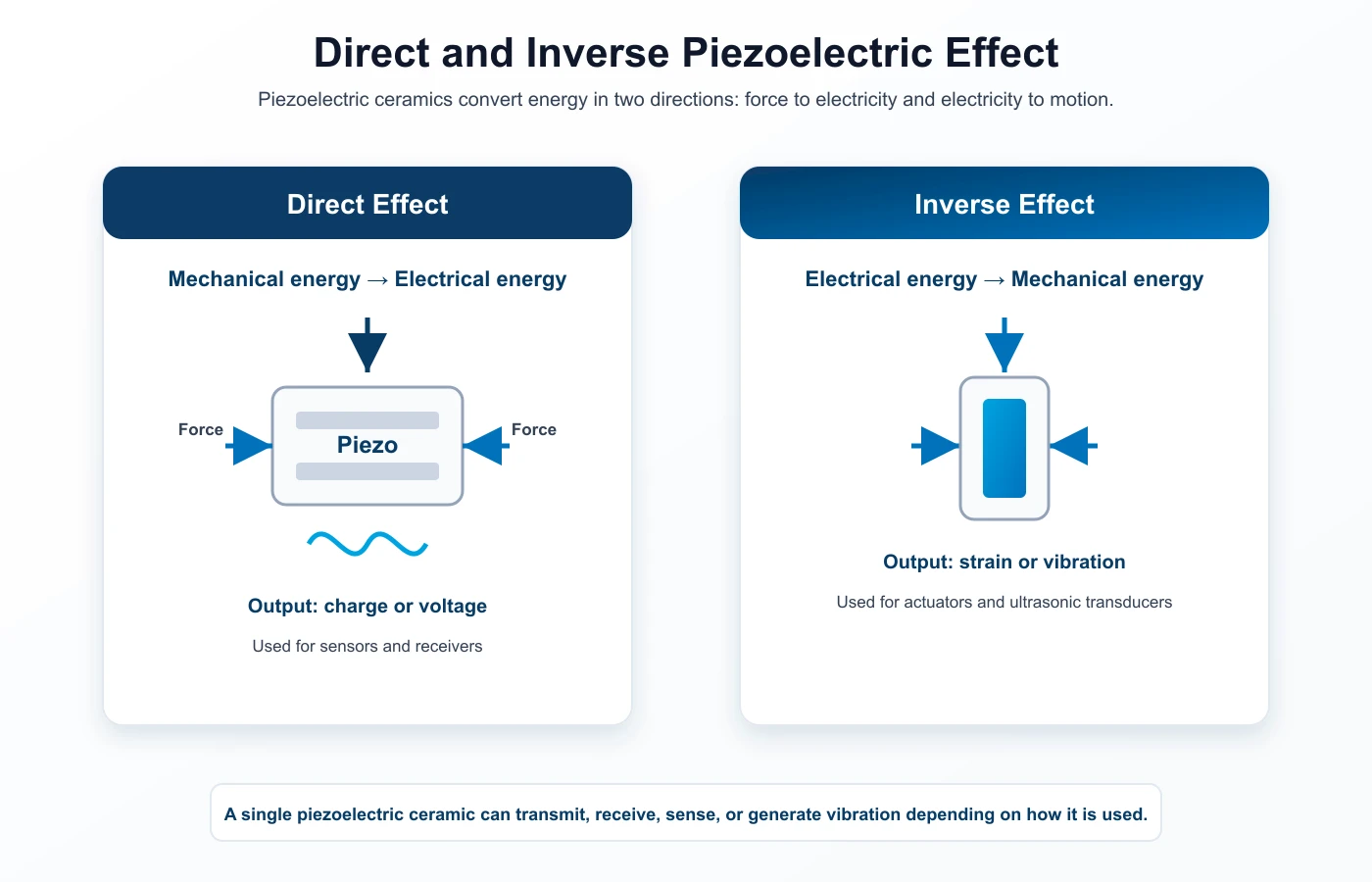
The direct piezoelectric effect occurs when mechanical pressure, force, vibration, or deformation generates electrical charge on the surface of a piezoelectric material.
In simple terms:
Mechanical energy → Electrical energy
When a piezoelectric ceramic element is compressed, stretched, bent, or vibrated, the internal charge distribution changes. This produces an electrical signal that can be measured by an external circuit.
This effect is also known as the generator effect or sensor effect because it allows the material to generate an electrical output from mechanical input.
Typical applications include:
- Pressure sensors
- Vibration sensors
- Accelerometers
- Acoustic receivers
- Ultrasonic sensors
- Hydrophones
- Knock sensors
- Impact and force detection
In these applications, the piezoelectric element converts physical movement or force into a useful electrical signal.
What Is the Inverse Piezoelectric Effect?
The inverse piezoelectric effect occurs when an applied electrical voltage causes a piezoelectric material to change shape. Depending on the material, polarization direction, and electrode arrangement, the element may expand, contract, bend, or vibrate.
In simple terms:
Electrical energy → Mechanical energy
This effect is also called the actuator effect because the material produces controlled mechanical motion when driven by an electrical signal.
Typical applications include:
- Piezo actuators
- Precision positioning devices
- Ultrasonic transducers
- Ultrasonic cleaning systems
- Ultrasonic welding systems
- Ultrasonic cutting systems
- Ultrasonic homogenizers
- Buzzers and sounders
- Inkjet and micro-dispensing devices
In ultrasonic applications, the inverse piezoelectric effect is especially important because it allows the ceramic element to convert high-frequency electrical energy into mechanical vibration.
Piezoelectric Effect in Crystals and Ceramics
The piezoelectric effect can occur in both monocrystalline materials and polycrystalline ferroelectric ceramics.
In single-crystal materials, the effect is related to asymmetry in the crystal lattice. When the crystal structure has no center of symmetry, mechanical stress can change the distribution of electric charge and create a measurable electrical output.
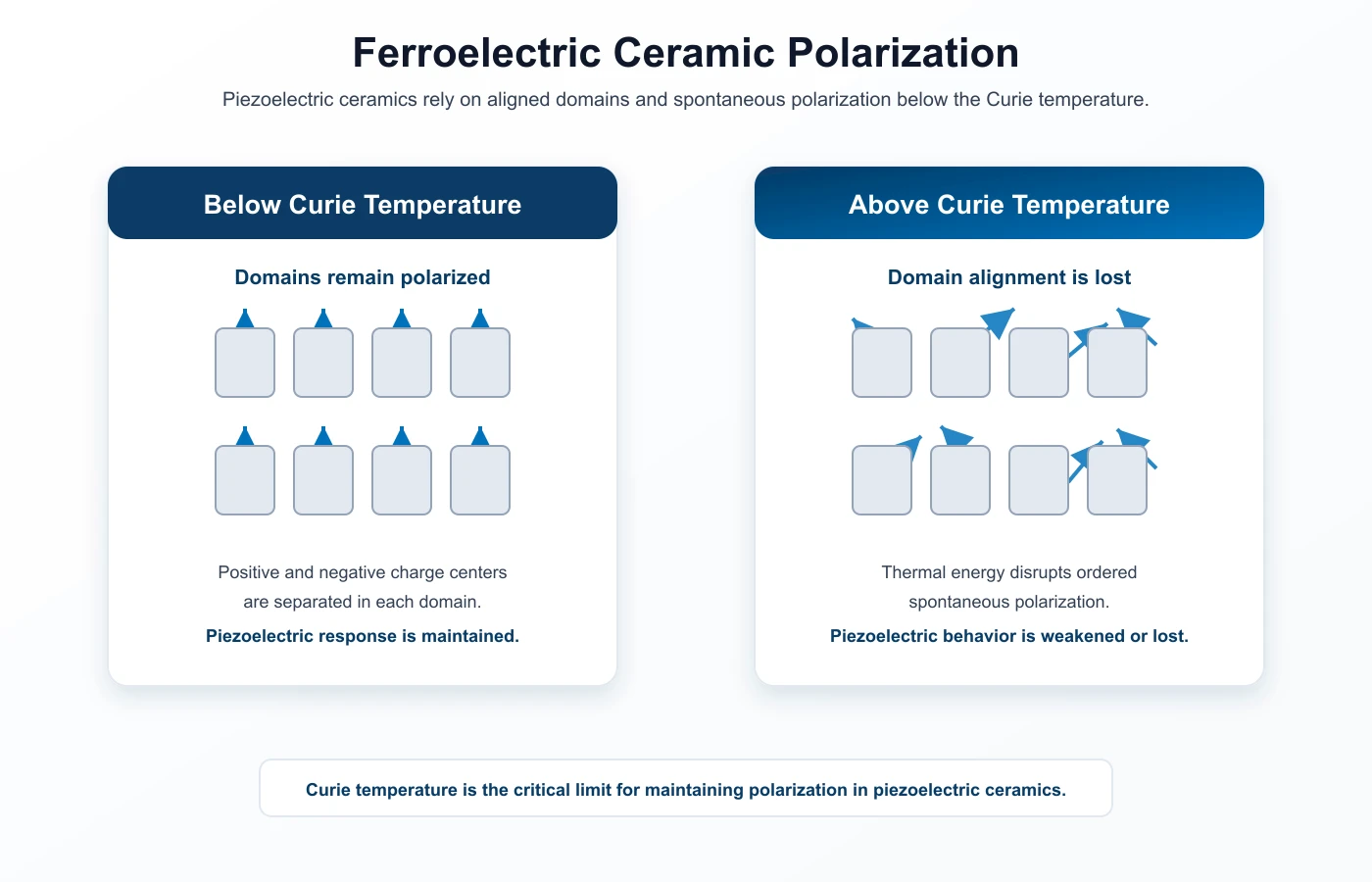
In ferroelectric ceramics, such as PZT, the material contains many small regions called domains. Each domain has spontaneous polarization, meaning the positive and negative charge centers are naturally separated. During the polarization process, many of these domains are aligned in a preferred direction, giving the ceramic its strong piezoelectric properties.
Below the Curie temperature, the material maintains this polarized structure. If the material is heated above the Curie temperature, the domain alignment is lost and the ceramic no longer behaves as a polarized piezoelectric material.
Why Polarization Matters
Piezoelectric ceramic materials must usually be polarized before they can be used effectively. During polarization, a strong electric field is applied to align the internal domains of the ceramic.
After polarization, the ceramic has a defined positive and negative direction. This direction determines how the ceramic responds to force and voltage.
For example:
- A force applied along the polarization direction can generate charge.
- A voltage applied across the electrodes can cause expansion or contraction.
- An alternating voltage can make the ceramic vibrate at the same frequency as the electrical signal.
This is why polarization direction, electrode design, and ceramic geometry are critical in piezoelectric component design.
Direct vs. Inverse Piezoelectric Effect
The two effects are closely connected, but they are used for different purposes.
| Effect | Input | Output | Typical Use |
|---|---|---|---|
| Direct piezoelectric effect | Force, pressure, vibration | Electrical charge or voltage | Sensors and receivers |
| Inverse piezoelectric effect | Electrical voltage or field | Mechanical deformation or vibration | Actuators and ultrasonic transducers |
In many devices, both effects may be used. For example, an ultrasonic sensor may transmit sound using the inverse effect and receive the echo using the direct effect.
Importance in Ultrasonic Technology
For ultrasonic systems, the inverse piezoelectric effect is used to generate ultrasonic vibration, while the direct piezoelectric effect can be used to receive reflected signals.
This makes piezoelectric ceramics essential in:
- Ultrasonic cleaning transducers
- Ultrasonic welding transducers
- Ultrasonic cutting systems
- Ultrasonic homogenizers and sonicators
- Ultrasonic sensors
- Medical ultrasound probes
- Sonar transmitters and receivers
By selecting the right piezo ceramic material, shape, electrode, and polarization direction, engineers can optimize the device for power output, sensitivity, frequency response, stability, and long-term reliability.
The direct and inverse piezoelectric effects are the foundation of piezoelectric ceramic technology. The direct effect converts mechanical energy into electrical energy, making it useful for sensing and receiving. The inverse effect converts electrical energy into mechanical deformation or vibration, making it useful for actuators and ultrasonic devices.
Understanding these two effects helps explain why piezoelectric ceramics are widely used in sensors, actuators, acoustic devices, ultrasonic transducers, medical equipment, industrial cleaning, welding, cutting, and many other advanced technologies.

Leave A Comment