
Piezo Element Behavior:
Piezoelectric ceramic elements are widely used in sensors, actuators, ultrasonic transducers, buzzers, medical devices, and high-power ultrasonic systems. Their behavior is based on the ability to convert mechanical energy into electrical energy and electrical energy into mechanical vibration.
To design a reliable piezoelectric component, it is important to understand how the ceramic responds to force, voltage, frequency, temperature, and mechanical stress. These factors directly affect sensitivity, displacement, resonance behavior, energy conversion efficiency, and long-term stability.
Behavior at Low Input Frequencies
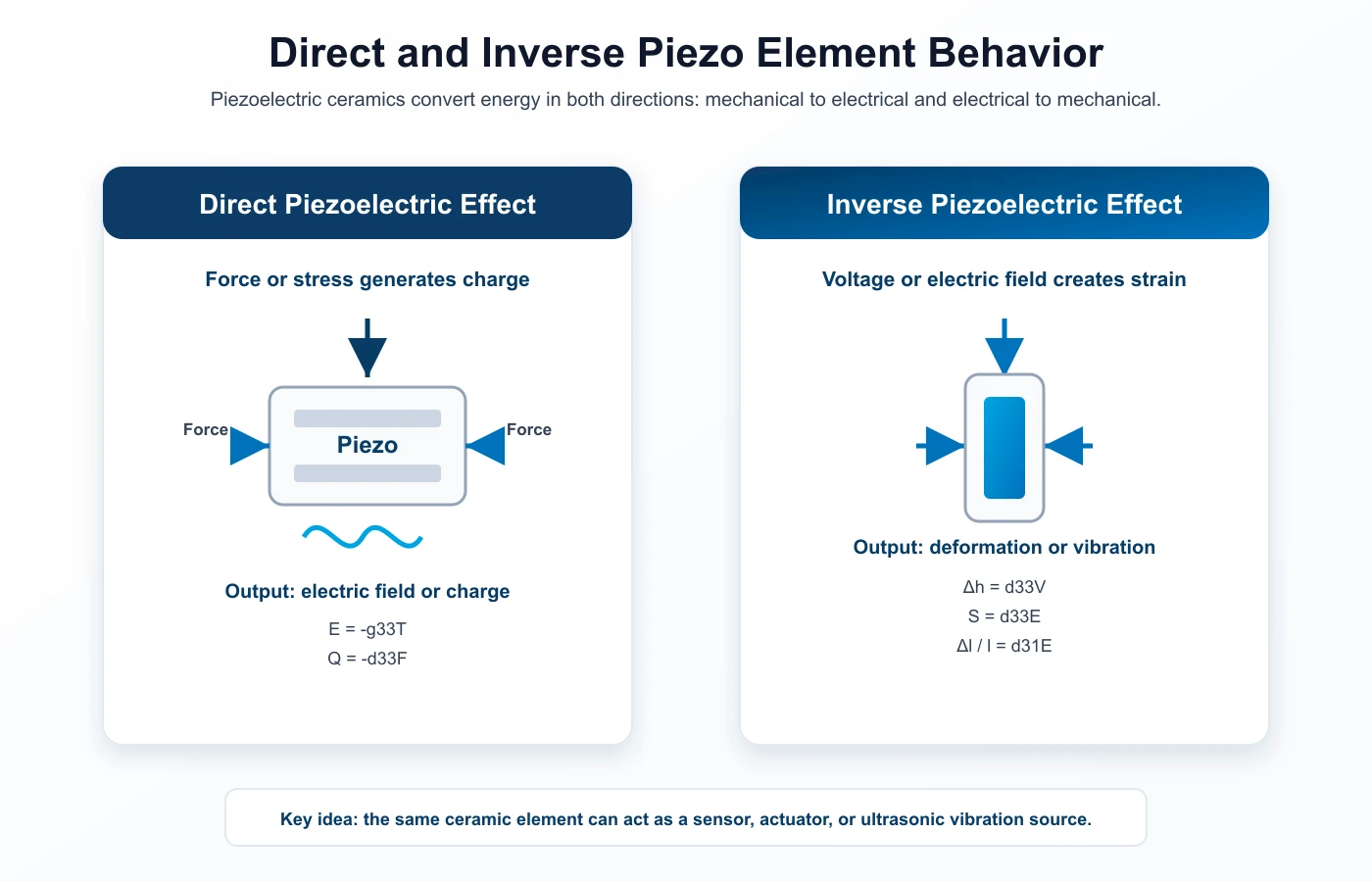
At low input frequencies, the relationship between mechanical force and electrical output can be described by the direct piezoelectric effect. When a force or stress is applied to a polarized piezoelectric ceramic element, the material generates an electric field or electric charge.
Common relationships include:
E = -g33T
Q = -d33F
Where:
- E is the generated electric field
- g33 is the piezoelectric voltage constant
- T is the stress applied to the ceramic element
- Q is the generated charge
- d33 is the piezoelectric charge constant
- F is the applied force
These relationships are important for sensors, receivers, pressure detection, vibration monitoring, and other applications where mechanical input must be converted into an electrical signal.
Deformation Under Applied Voltage
Piezoelectric ceramic elements also exhibit the inverse piezoelectric effect. When an electric field or voltage is applied, the ceramic changes dimension. Depending on the polarization direction and ceramic geometry, the thickness, length, or width of the element may increase or decrease.
Typical relationships include:
Δh = d33V
S = d33E
Δl / l = d31E
Δw / w = d31E
Where:
- l is the original length of the ceramic element
- w is the original width of the ceramic element
- Δh is the change in height or thickness
- Δl is the change in length
- Δw is the change in width
- S is strain
- V is the applied voltage
- E is the applied electric field
- d33 and d31 are piezoelectric charge constants
This behavior is the basis for actuators, precision positioning devices, ultrasonic transducers, and other components that require controlled mechanical motion.
Influence of Input Frequency
When a piezoelectric ceramic element is exposed to an alternating electric field, it changes dimensions cyclically at the same frequency as the applied field. As the input frequency changes, the vibration response and impedance of the element also change.
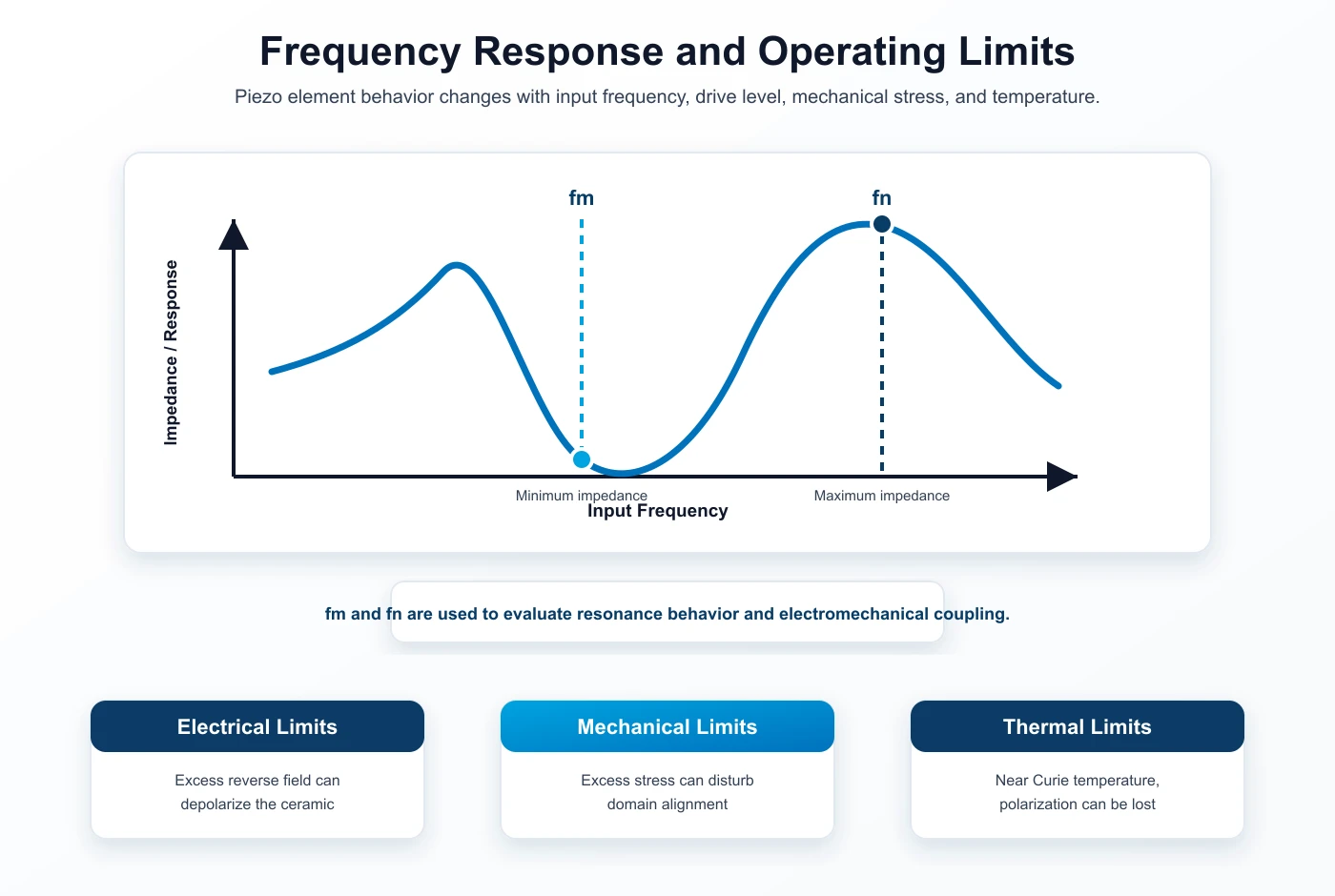
At a certain frequency, the ceramic element vibrates most readily and converts electrical energy into mechanical energy most efficiently. This is known as the resonance frequency.
As the driving frequency increases, the element first reaches a point where impedance is at its minimum and admittance is at its maximum. This point is commonly referred to as the minimum impedance frequency, fm, and is closely related to the resonance frequency.
As the frequency continues to increase, the impedance rises to a maximum and admittance falls to a minimum. This point is known as the maximum impedance frequency, fn, and is related to the anti-resonance frequency.
The values of fm and fn are typically determined experimentally using an impedance analyzer or frequency sweep system.
Electromechanical Coupling and Losses
The minimum impedance frequency and maximum impedance frequency can be used to calculate the electromechanical coupling factor, k. This factor indicates how effectively a piezoelectric material converts electrical energy into mechanical energy, or mechanical energy into electrical energy.
The coupling factor depends on:
- Vibration mode
- Ceramic shape
- Polarization direction
- Material composition
- Mechanical boundary conditions
However, coupling factor alone does not represent total efficiency. Dielectric losses and mechanical losses also affect energy conversion. In many piezoelectric ceramic elements, dielectric losses are more significant than mechanical losses, especially under high-frequency or high-drive operating conditions.
Stability and Aging
Most piezoelectric ceramic properties change gradually over time after polarization. This natural aging process often follows a logarithmic relationship with time. The exact aging rate depends on the ceramic composition, manufacturing process, polarization conditions, and storage or operating environment.
Proper handling and operation are important because exceeding electrical, mechanical, or thermal limits can accelerate aging and reduce performance.
Stable piezoelectric performance is especially important for ultrasonic transducers, precision sensors, medical devices, and high-power industrial systems where frequency, capacitance, and output consistency must remain within specification.
Electrical Limitations
A strong electric field applied in the opposite direction of the original polarization field can depolarize a piezoelectric ceramic material. The degree of depolarization depends on material grade, exposure time, temperature, and field strength.
In many cases, electric fields of approximately 200 to 500 V/mm or higher can produce a significant depolarizing effect. Alternating current can also contribute to depolarization during the half-cycle in which the electric field is opposite to the polarization direction.
For this reason, piezoelectric components must be operated within their recommended voltage and field limits.
Mechanical Limitations
Excessive mechanical stress can disturb the alignment of domains inside the ceramic and reduce piezoelectric performance. If the stress is high enough, it can damage the dipole alignment and cause permanent degradation.
The ability to withstand mechanical load varies by ceramic material, grade, geometry, and manufacturing process. High-power ultrasonic transducers, for example, often require hard piezoelectric ceramics because they can better withstand strong electrical and mechanical drive conditions.
Thermal Limitations
Temperature is another critical factor. If a piezoelectric ceramic material is heated to its Curie temperature, the domains become disordered and the material loses its polarization.
The recommended upper operating temperature is usually well below the Curie temperature. Within the recommended range, temperature-related changes in domain orientation are generally reversible. However, rapid temperature changes can generate charge displacement and high electric fields, which may affect stability or even cause depolarization.
In some systems, a capacitor may be added to absorb excess electrical energy caused by sudden thermal changes.
Pyroelectric Effects
Piezoelectric ceramics can also generate electrical charge when their temperature changes. This is known as the pyroelectric effect. The vulnerability of a material to pyroelectric effects can be evaluated using pyroelectric charge and field strength constants.
A material with a high ratio of piezoelectric charge constant to pyroelectric charge constant, or piezoelectric voltage constant to pyroelectric field strength constant, generally offers better resistance to pyroelectric effects.
This is important in applications where the ceramic may experience temperature fluctuations, such as outdoor sensors, industrial ultrasonic systems, and thermally dynamic environments.
Piezo element behavior is influenced by electrical input, mechanical stress, frequency, temperature, geometry, and material composition. At low frequencies, piezoelectric ceramics can be described through direct and inverse piezoelectric relationships. At higher frequencies, resonance, anti-resonance, impedance, and coupling factor become critical.
For reliable performance, piezoelectric ceramic elements must be designed and operated within their electrical, mechanical, and thermal limits. Proper material selection, dimensional design, frequency testing, and environmental control help ensure stable output, efficient energy conversion, and long service life in sensors, actuators, and ultrasonic transducers.

Leave A Comment