
What Are Piezoelectric Sensors?
Piezoelectric sensors are devices that convert mechanical energy, such as pressure, force, strain, vibration, or acceleration, into an electrical signal. They are widely used in industrial measurement, structural monitoring, ultrasonic systems, precision instruments, automotive electronics, medical devices, and many other applications where fast and reliable signal response is required.
Among different piezoelectric materials, piezoceramic materials are especially important because they offer strong sensitivity, stable performance, flexible geometry, and good compatibility with mass production. One of the most widely used piezoceramic materials is lead zirconate titanate, commonly known as PZT.
For companies working with piezoelectric ceramics, ultrasonic transducers, and ultrasonic processing equipment, piezoelectric sensors are more than simple measuring components. They are part of the same energy conversion technology that supports ultrasonic detection, vibration monitoring, power control, and precision feedback in advanced electro-mechanical systems.
How Piezoelectric Materials Work
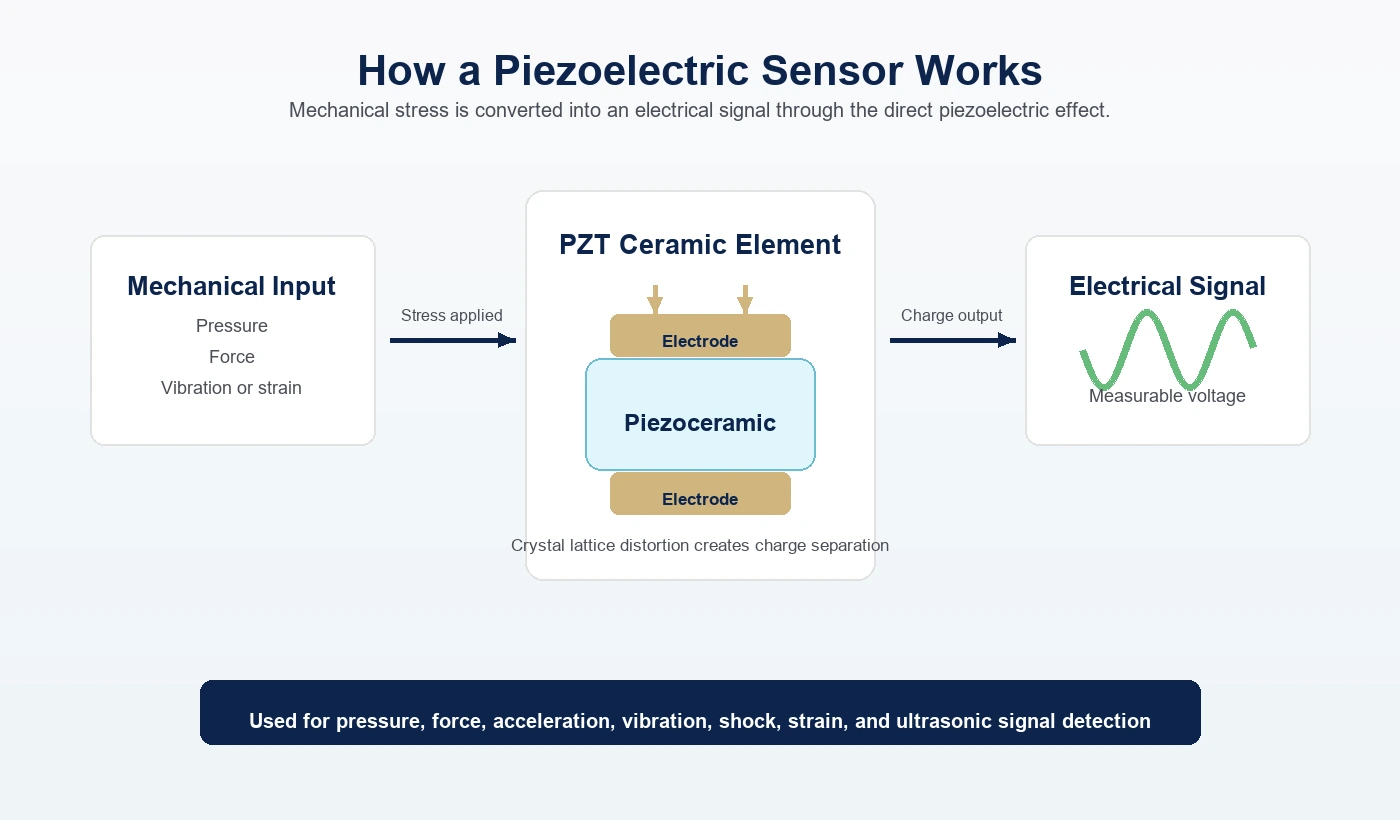
Piezoelectric materials can generate an electrical charge when they are subjected to mechanical stress. This behavior is called the direct piezoelectric effect. When pressure, compression, bending, vibration, or strain is applied to the material, its internal crystal structure becomes slightly distorted. This distortion creates a charge separation inside the material, producing a measurable electrical signal.
Piezoelectric materials can also work in the opposite direction. When an electrical voltage is applied, the material expands, contracts, or vibrates. This is called the inverse piezoelectric effect. The direct effect is the basis of piezoelectric sensors, while the inverse effect is the basis of many actuators, buzzers, ultrasonic transducers, and ultrasonic equipment.
For a material to show strong piezoelectric behavior, its crystal structure must be non-centrosymmetric. In simple terms, the positive and negative charge centers inside the material cannot be perfectly balanced in every direction. When external force changes the crystal structure, the charge distribution changes and a voltage appears across the material.
What Is a Piezoceramic Sensor?
A piezoceramic sensor is a sensor that uses a ceramic piezoelectric material as its active sensing element. Ceramic materials are inorganic and non-metallic, and they can include oxides, nitrides, carbides, and other engineered compounds. In sensor applications, PZT ceramic is one of the most common choices because it provides a strong piezoelectric response and can be manufactured into discs, plates, rings, tubes, and customized shapes.
When a physical change acts on the piezoceramic element, the ceramic generates an electrical charge. This signal can then be collected, conditioned, and converted into useful measurement data.
Piezoceramic sensors can be designed to detect:
- Pressure
- Force
- Acceleration
- Vibration
- Shock
- Strain
- Dynamic load
- Acoustic and ultrasonic signals
Because the response is fast, piezoceramic sensors are especially suitable for dynamic measurements, such as vibration analysis, impact detection, acoustic emission monitoring, and high-frequency ultrasonic sensing.
Common Sensor Structures
The structure of a piezoelectric sensor depends on the application. In a simple force or pressure sensor, the external load acts directly on the piezoceramic element. The ceramic then generates an electrical charge proportional to the mechanical input.
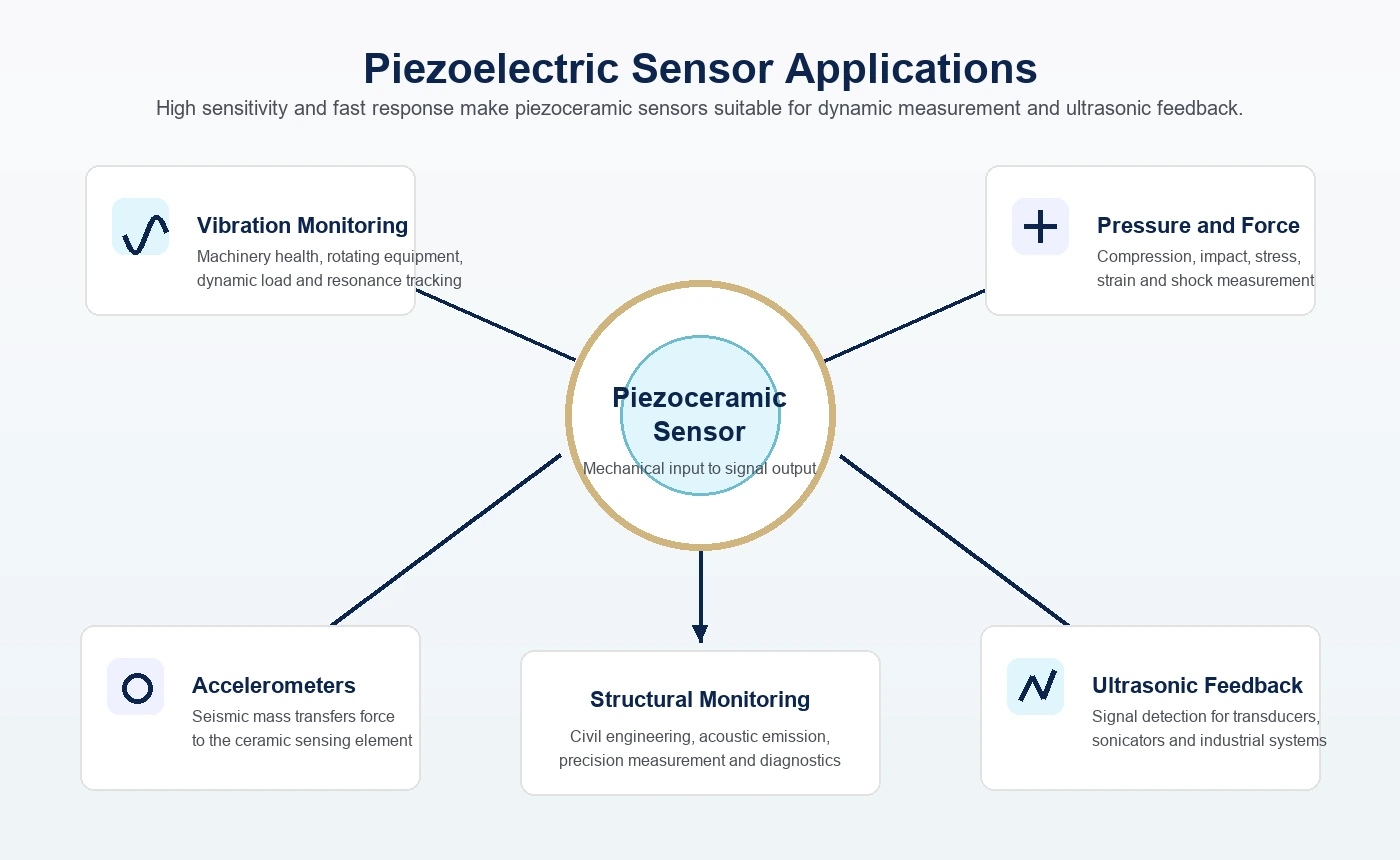
In an accelerometer, the operating structure is different. A small seismic mass is attached to or placed near the piezoceramic element. When the object accelerates, the mass applies force to the ceramic. The ceramic converts this force into an electrical signal, allowing the acceleration to be measured.
This is why piezoelectric sensors can be used in both direct sensing and indirect sensing designs. The sensing element may receive the force directly, or it may measure force transferred through another mechanical structure.
Where Piezoelectric Sensors Are Used
Piezoelectric sensors are selected when engineers need fast response, high sensitivity, compact size, and reliable operation under demanding conditions. They are commonly used in:
- Industrial vibration monitoring
- Machinery health diagnosis
- Pressure and force measurement
- Shock and impact detection
- Structural health monitoring
- Civil engineering strain measurement
- Acoustic emission detection
- Ultrasonic receiving and detection
- Automotive engine and knock sensing
- Medical ultrasonic devices
- Precision instruments and laboratory equipment
In ultrasonic systems, piezoelectric sensing can be used to monitor vibration, detect feedback signals, measure acoustic response, or support frequency and power control. For ultrasonic homogenizers, ultrasonic welding systems, and ultrasonic transducers, reliable sensing and feedback can help improve stability, efficiency, and process repeatability.
Advantages of Piezoceramic Sensors
Piezoceramic sensors offer several important advantages for industrial and technical applications.
First, they provide high sensitivity. Even small mechanical changes can generate measurable electrical signals, which makes them suitable for detecting vibration, shock, and small dynamic forces.
Second, they respond very quickly. This allows them to capture high-frequency events that slower sensing technologies may miss.
Third, they can be produced in different shapes and sizes. Discs, plates, rings, tubes, and custom ceramic geometries can be selected according to the mechanical design of the final product.
Fourth, piezoceramic materials are generally durable and stable under repeated dynamic loading. Although the ceramic element experiences stress during operation, the physical deformation is very small, helping the sensor maintain long service life when properly designed.
Finally, piezoceramic sensors have good resistance to electromagnetic interference. This is useful in industrial environments where motors, power supplies, ultrasonic generators, and other electrical systems may create noise.
Important Design Considerations
Although piezoelectric sensors are highly versatile, correct material and structure selection are essential. Engineers normally need to consider:
- Required sensitivity
- Frequency range
- Mechanical load
- Operating temperature
- Sensor geometry
- Signal conditioning circuit
- Mounting method
- Environmental protection
- Long-term stability
For dynamic force, vibration, acceleration, and ultrasonic signal detection, the ceramic material, electrode design, preload condition, and packaging structure all influence the final performance.
In many applications, the sensor is not selected only as a single component. It must be matched with the entire system, including the mechanical structure, electronic circuit, signal processing method, and operating environment.
Summary
Piezoelectric sensors use the direct piezoelectric effect to convert pressure, force, vibration, strain, acceleration, and shock into electrical signals. Piezoceramic materials such as PZT are widely used because they offer high sensitivity, fast response, compact structure, flexible geometry, and reliable performance.
From industrial monitoring and precision measurement to ultrasonic transducers and advanced ultrasonic equipment, piezoelectric sensors play an important role in connecting mechanical motion with electronic control.
For manufacturers and system designers, choosing the right piezoceramic material and sensor structure can improve measurement accuracy, response speed, equipment stability, and long-term reliability.

Leave A Comment