
What Is Ultrasound?
Ultrasound refers to sound waves with frequencies higher than the upper limit of human hearing. In general, any sound wave above 20 kHz is considered ultrasound. Although humans cannot hear these high-frequency vibrations, ultrasonic energy can be generated, controlled, transmitted, and applied in many useful ways.
Today, ultrasound is widely used in medical imaging, industrial inspection, ultrasonic cleaning, plastic welding, ultrasonic cutting, liquid processing, sensors, flow measurement, and many other technical fields. In industrial ultrasonic systems, the piezoelectric transducer is one of the most important components because it converts electrical energy into high-frequency mechanical vibration.

How Ultrasound Differs from Audible Sound
Sound is a mechanical wave that travels through a medium such as air, water, metal, plastic, or ceramic. The main difference between audible sound and ultrasound is frequency.
Human hearing normally covers a range of about 20 Hz to 20 kHz. Ultrasound begins above this range. Because ultrasonic waves have shorter wavelengths than audible sound, they can be directed, focused, reflected, and used for precise measurement or high-intensity processing.
In practical applications, different ultrasonic frequencies are selected for different purposes. Lower ultrasonic frequencies are often used for high-power applications such as welding, cleaning, cutting, and homogenization. Higher frequencies are commonly used for sensing, measurement, inspection, and imaging.
How Ultrasound Is Generated
Most modern ultrasonic systems generate ultrasound using a piezoelectric transducer. Inside the transducer, piezoelectric ceramic elements expand and contract when an alternating electrical signal is applied. This rapid movement creates mechanical vibration at an ultrasonic frequency.
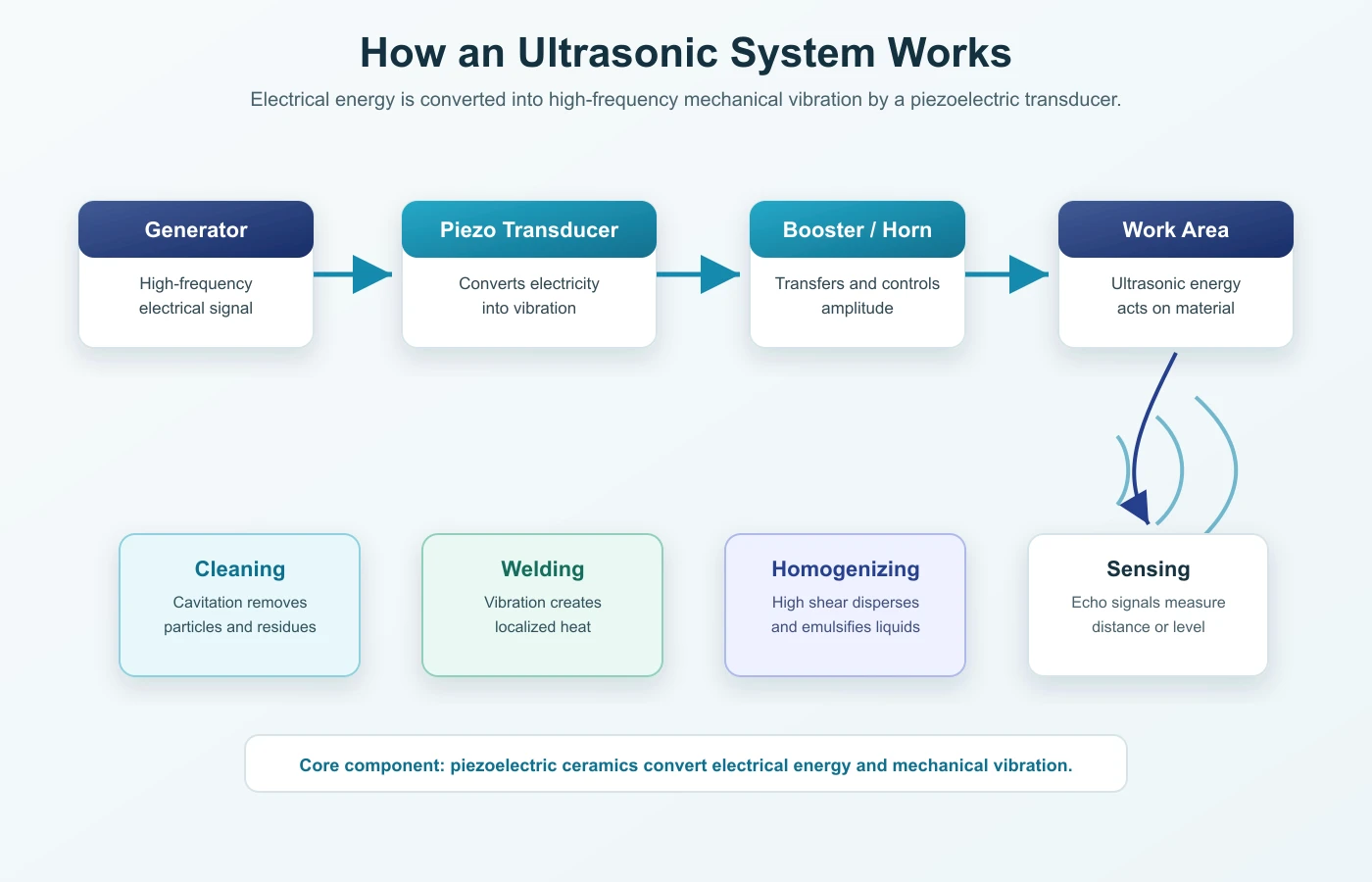
In a complete ultrasonic system, the generator supplies high-frequency electrical energy, the transducer converts it into mechanical vibration, and the horn, probe, or tool transfers the vibration to the working area.
For example:
- In ultrasonic welding, vibration is transferred to the plastic joint area.
- In ultrasonic cleaning, vibration creates cavitation in liquid.
- In ultrasonic homogenization, a probe transfers high-intensity energy into a sample.
- In ultrasonic sensing, a transducer sends and receives sound waves for detection or measurement.
Low-Power and High-Power Ultrasound
Ultrasound can be divided into two broad categories: low-power ultrasound and high-power ultrasound.
Low-power ultrasound is mainly used to collect information. The ultrasonic energy is controlled so that it does not significantly change the target material. Applications include ultrasonic sensors, level measurement, flow measurement, thickness measurement, non-destructive testing, and medical imaging.
High-power ultrasound is used to actively process materials. In these applications, ultrasonic vibration produces physical effects such as cavitation, frictional heating, dispersion, emulsification, cutting, or welding. Applications include ultrasonic welding, cleaning, cutting, sonochemistry, homogenization, extraction, and cell disruption.
What Is Cavitation?
Cavitation is one of the most important effects in liquid ultrasonic applications. When high-intensity ultrasound passes through a liquid, it creates alternating high-pressure and low-pressure cycles. During the low-pressure phase, microscopic bubbles can form. These bubbles then collapse rapidly during the high-pressure phase.
This collapse releases localized energy, creating strong micro-mixing, shock waves, and high shear forces. Cavitation is the key mechanism behind ultrasonic cleaning, homogenization, emulsification, dispersion, extraction, and many sonochemical processes.
Common Industrial Applications of Ultrasound
Ultrasound is used across many industries because it can deliver energy precisely, quickly, and without direct mechanical contact in many cases.
Common applications include:
- Ultrasonic cleaning: Removes oil, particles, polishing compounds, and contaminants from complex parts.
- Ultrasonic welding: Joins thermoplastic components quickly and cleanly without adhesives.
- Ultrasonic cutting: Reduces cutting resistance and improves edge quality for soft, sticky, or layered materials.
- Ultrasonic homogenization: Disperses particles, creates emulsions, breaks cells, and improves liquid mixing.
- Ultrasonic sensing: Measures distance, detects objects, and monitors liquid levels.
- Ultrasonic testing: Detects cracks, voids, thickness changes, and internal defects without damaging the part.
- Medical ultrasound: Produces images using reflected high-frequency sound waves.
Why Piezoelectric Materials Matter
The performance of an ultrasonic system depends strongly on the piezoelectric material and transducer design. Piezoelectric ceramics determine how efficiently electrical energy is converted into mechanical vibration, as well as how stable the system is under different operating conditions.
Key material and design factors include:
- Resonance frequency
- Electromechanical coupling
- Mechanical quality factor
- Dielectric loss
- Capacitance
- Vibration amplitude
- Thermal stability
- Power handling capability
For high-power applications such as ultrasonic welding, cleaning, cutting, and homogenization, stable piezoelectric ceramics and well-designed transducers are essential for reliable performance and long service life.
Ultrasound is more than simply “sound above human hearing.” It is a powerful and versatile technology that can be used to detect, measure, clean, weld, cut, mix, disperse, and process materials.
From low-power sensors to high-power ultrasonic transducers, the correct choice of frequency, power level, piezoelectric ceramic, generator, and tooling directly affects system performance. With the right ultrasonic solution, manufacturers can improve processing efficiency, product quality, repeatability, and long-term reliability.

Leave A Comment