
Semiconductor refrigeration, also known as thermoelectric cooling, is a compact and reliable temperature-control technology based on the Peltier effect. Unlike traditional compressor-based refrigeration, a thermoelectric cooling system has no refrigerant, no complex piping, and no moving compressor. This makes it suitable for applications that require compact size, precise temperature control, low vibration, and high reliability.
In this model design, a TEC1-12703 thermoelectric cooling module is used as the cooling plate. The system is designed to support heat dissipation for a solar LED lighting system, where stable thermal management is important for improving performance and service life. The refrigerator wall uses organic glass because of its transparency, toughness, and heat resistance. To achieve effective and controllable cooling, a dedicated controller is used to regulate the semiconductor refrigeration module.
Structure of the Semiconductor Refrigeration System
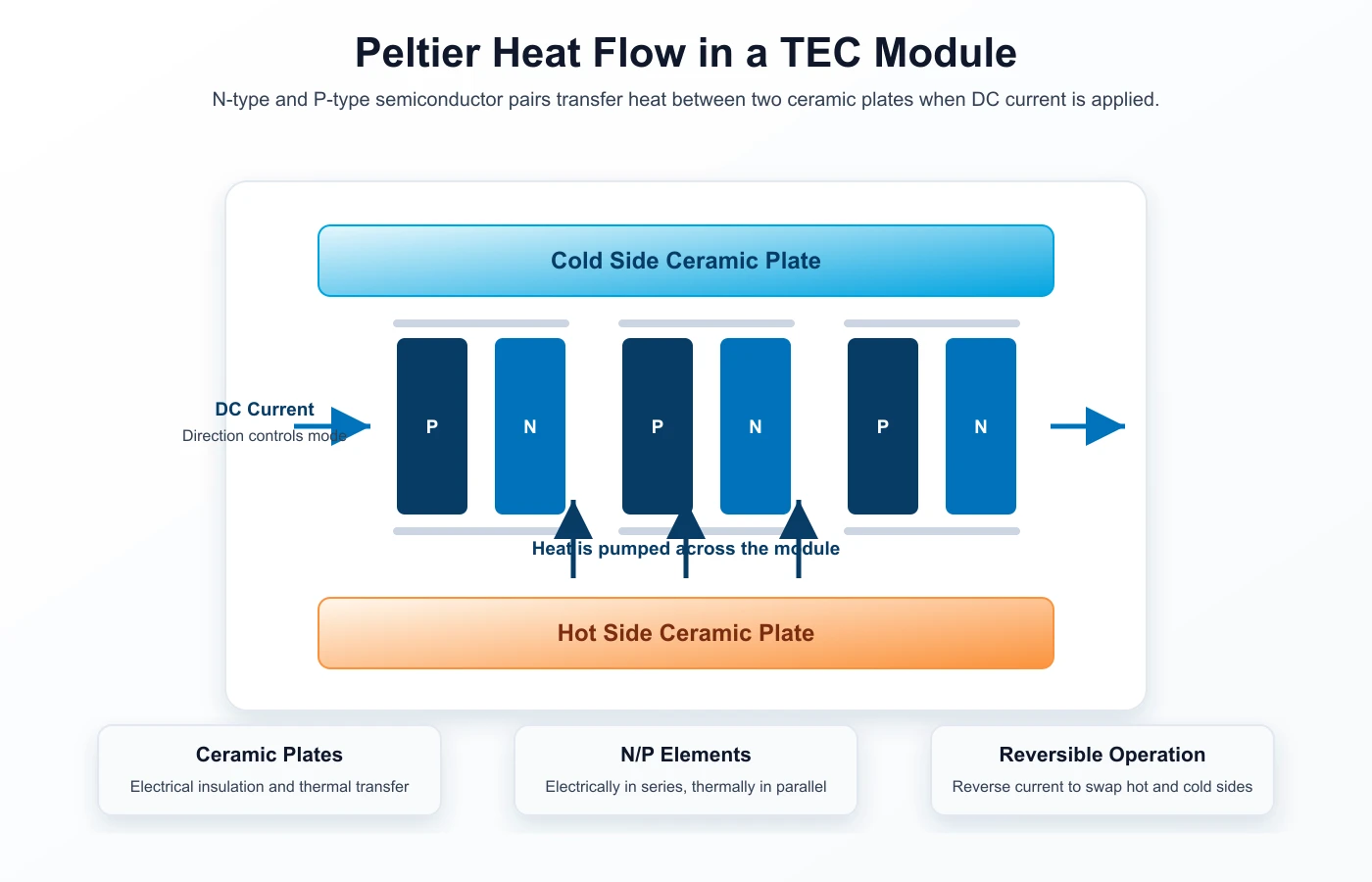
The refrigeration system is built around a thermoelectric cooling module. When a DC voltage is applied to the TEC module, current flows through a series of N-type and P-type semiconductor elements. Due to the Peltier effect, heat is absorbed on one side of the module and released on the other side. As a result, one surface becomes the cold side, while the opposite surface becomes the hot side.
The basic structure includes:
- TEC1-12703 semiconductor refrigeration module
- N-type and P-type semiconductor elements
- Conductive metal interconnects, typically copper or aluminum
- Upper and lower ceramic plates for insulation, support, and heat transfer
- Organic glass wall for the refrigeration chamber
- Temperature sensor and control circuit
- Power drive circuit for TEC current control
The ceramic plates play an important role in the module structure. They provide electrical insulation, mechanical support, and thermal transfer between the semiconductor elements and the external heat exchange surfaces. In applications involving advanced functional ceramics, material stability and thermal performance are especially important for long-term operation.
Control Principle of the Semiconductor Refrigeration Module
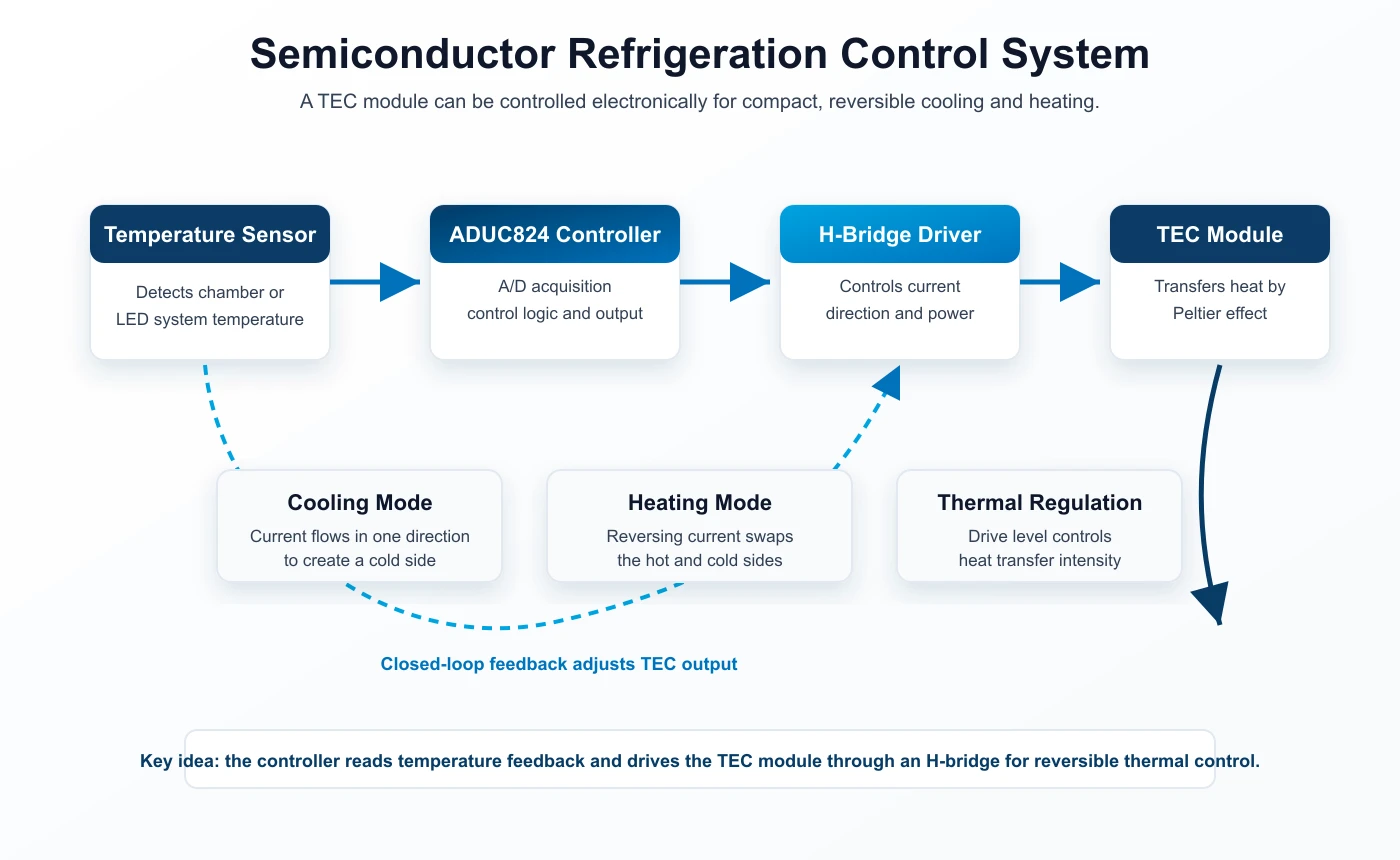
The TEC module can operate in both cooling and heating modes. When DC current flows in one direction, one side of the module becomes cold and the other side becomes hot. When the current direction is reversed, the hot and cold sides are exchanged.
This reversible operating characteristic allows the system to perform temperature regulation instead of simple one-way cooling. By controlling current direction and power level, the system can adjust the refrigeration effect according to the actual thermal condition of the solar LED lighting system.
Controller Design Based on ADUC824
To improve control accuracy and simplify circuit design, the system uses ADUC824 as the main control core. ADUC824 is a high-performance microcontroller based on an 8051 core. It integrates multiple useful functions, including A/D conversion, D/A conversion, Flash memory, watchdog timer, microprocessor monitoring, temperature sensing, SPI interface, and I2C interface.
Because these functions are integrated in one compact device, the controller can reduce external circuit complexity while improving overall system reliability. Software programming is used to complete temperature acquisition, control calculation, and output regulation.
The controller receives temperature feedback from the sensing circuit, compares it with the target setting, and then adjusts the TEC drive circuit accordingly. This enables the system to maintain a more stable temperature under changing environmental or load conditions.
H-Bridge Drive for Bidirectional Current Control
The semiconductor refrigeration power drive uses an H-bridge, also known as a full-bridge circuit. This circuit allows bidirectional current control through the TEC module under a single power supply.
The H-bridge is important because the direction of current determines whether a specific side of the TEC module becomes hot or cold. By changing the current direction, the controller can switch between cooling and heating modes. By adjusting the drive level, the system can control the intensity of heat transfer.
This design provides a flexible method for active thermal management and helps the refrigeration system respond to different operating requirements.
Advantages of Semiconductor Refrigeration
Compared with traditional refrigeration methods, semiconductor refrigeration offers several practical advantages:
- Compact structure
- No refrigerant leakage risk
- No compressor or complex welded piping
- Low vibration and low noise
- Fast thermal response
- Reversible cooling and heating
- Precise temperature control through electronic regulation
- Suitable for small thermal management systems
These advantages make thermoelectric cooling useful for LED thermal management, electronics cooling, laboratory equipment, optical systems, sensors, and other compact temperature-control applications.
In a Word
The semiconductor refrigeration model combines a TEC thermoelectric module, ceramic structural components, an ADUC824-based controller, and an H-bridge power drive circuit. Through bidirectional current control, the system can regulate heat transfer and switch between cooling and heating modes.
For applications such as solar LED lighting systems, this design provides a compact and controllable method for thermal management. By combining reliable ceramic materials, efficient thermoelectric modules, and intelligent electronic control, the system can improve temperature stability, reduce structural complexity, and support long-term equipment performance.

Leave A Comment