
Piezoelectric Ceramic as an Electronic Sounding Element
How a Piezoelectric Ceramic Sounder Works
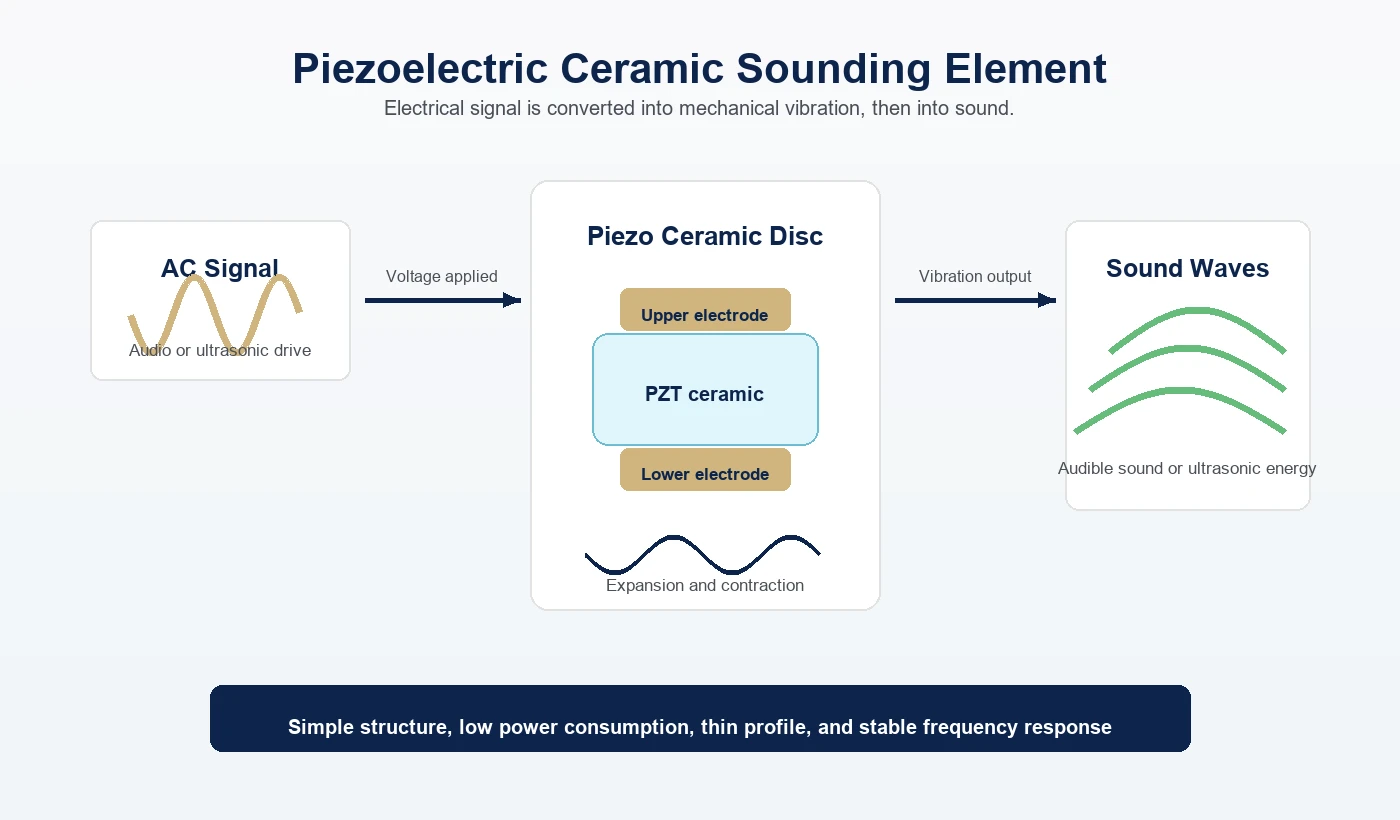
A typical piezoelectric ceramic sounder consists of three main parts:
- A piezoelectric ceramic layer
- Two conductive electrodes
- A supporting metal or ceramic structure
When an alternating voltage is applied, the electric field causes the ceramic material to deform. As the voltage changes direction, the ceramic vibrates back and forth. These vibrations are transferred to the surrounding medium, creating audible sound or ultrasonic vibration depending on the driving frequency.
Compared with traditional electromagnetic sounders, piezoelectric ceramic sounders offer several practical advantages:
- Simple and lightweight structure
- Low power consumption
- Thin profile for compact product design
- Good response in the mid-to-high frequency range
- Stable performance and long service life
- Competitive cost for mass production
These advantages make piezoelectric ceramic components especially suitable for applications where space, energy efficiency, and reliability are important.
From Sounding Elements to Ultrasonic Transducers
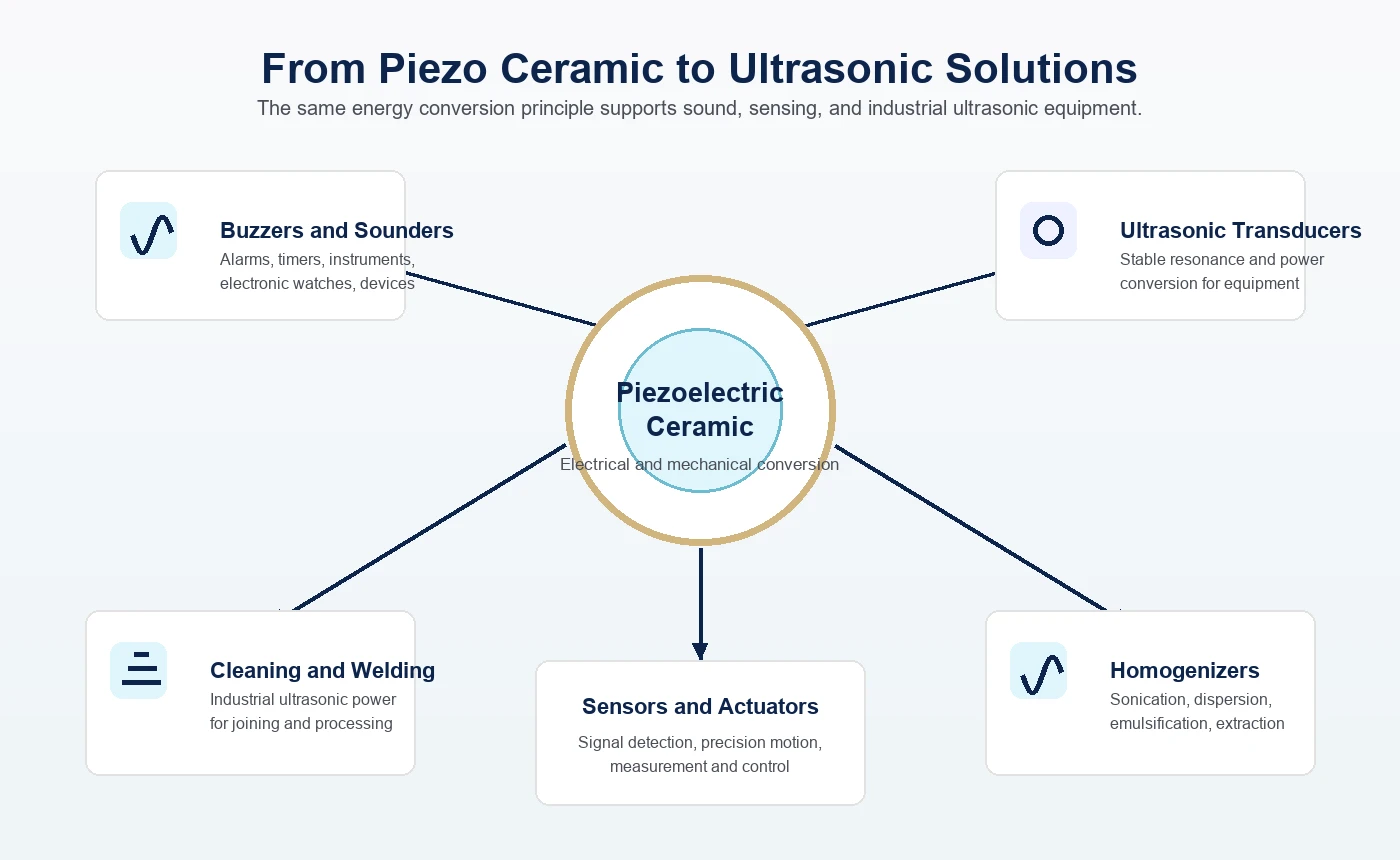
Although piezoelectric ceramic buzzers are a familiar example, the value of piezoelectric ceramics goes far beyond simple sound generation. In industrial and scientific equipment, piezoelectric ceramics are used as the core energy conversion element in ultrasonic transducers.
In an ultrasonic transducer, the ceramic is driven at a specific resonance frequency. The electrical signal is converted into high-frequency mechanical vibration, which can then be transmitted into a tool head, liquid medium, cleaning tank, welding horn, or other working structure.
This is why piezoelectric ceramics are critical in many ultrasonic applications, including:
- Ultrasonic homogenizers and sonicators
- Ultrasonic cleaning equipment
- Ultrasonic welding systems
- Ultrasonic cutting systems
- Ultrasonic sensors and receivers
- Ultrasonic motors and actuators
- Underwater acoustic transducers
- Precision measuring and detection instruments
For these applications, material selection is much more demanding than for simple buzzers. The ceramic must be matched to the required power level, resonance frequency, vibration mode, mechanical load, temperature condition, and long-term operating environment.
Key Material Requirements
Piezoelectric ceramic performance is usually evaluated by several important parameters. For high-performance sound and ultrasonic components, manufacturers often pay close attention to:
- Piezoelectric constant, such as d33
- Electromechanical coupling coefficient
- Mechanical quality factor, Qm
- Dielectric loss
- Capacitance and impedance
- Curie temperature
- Resonance and anti-resonance frequency
- Stability under high voltage and high mechanical load
For low-power sounders and signal devices, sensitivity, cost, and compact structure are often the main priorities. For power ultrasonic transducers, the ceramic material must also provide low loss, high mechanical strength, stable resonance, and reliable operation under continuous high-power driving.
Piezoelectric ceramic transformers also rely on the positive and inverse piezoelectric effects. They are excited near their resonant frequency, so the material must have strong electromechanical coupling and low dielectric loss. Lower loss helps reduce heat generation during operation, while higher vibration capability supports better voltage transformation and power efficiency.
Development of Piezoelectric Ceramic Materials
Traditional piezoelectric ceramics have stronger piezoelectric performance than many other piezoelectric materials, which is why they have been widely adopted in electro-acoustic, sensing, and ultrasonic products. However, as applications become smaller, thinner, more powerful, and more efficient, conventional materials do not always meet every design requirement.
In recent years, researchers and manufacturers have continued to develop improved piezoelectric materials with higher piezoelectric constants, stronger coupling, better strain response, and improved stability. High-performance single-crystal piezoelectric materials, for example, can offer very high d33 and k33 values and significantly larger strain than standard ceramic materials.
At the same time, mature PZT ceramic systems remain highly important in industrial applications because they provide a strong balance of performance, manufacturability, cost control, and reliability. For many ultrasonic transducers and industrial ultrasonic systems, the correct ceramic formulation and precise manufacturing process are just as important as the material category itself.
Why Piezoelectric Ceramic Selection Matters
A piezoelectric component is not only a small part inside a device. In many ultrasonic systems, it determines the efficiency, output stability, heat generation, service life, and overall performance of the equipment.
For example, an ultrasonic homogenizer requires a transducer that can convert electrical power into stable high-frequency vibration. If the ceramic material is not properly selected, the system may suffer from weak output, excessive heating, unstable resonance, reduced efficiency, or shorter working life.
This is why professional material selection and transducer design are essential for industries that use ultrasonic energy in production, laboratory processing, cleaning, welding, dispersion, emulsification, extraction, and other demanding processes.
in a word
Piezoelectric ceramics are essential electronic sounding and ultrasonic energy conversion materials. From simple buzzers and electronic alarms to advanced ultrasonic transducers and ultrasonic homogenizers, they enable efficient conversion between electrical signals and mechanical vibration.
With the continued demand for thinner electronics, higher-efficiency sound devices, and more reliable industrial ultrasonic equipment, piezoelectric ceramic materials will remain a key technology for both consumer products and professional ultrasonic systems.
For manufacturers and equipment designers, choosing the right piezoelectric ceramic material is the first step toward better acoustic output, higher ultrasonic efficiency, stable operation, and longer product life.

Leave A Comment