
Soft Piezo Ceramic vs. Hard Piezo Ceramic:
Piezoelectric ceramics are widely used in ultrasonic transducers, sensors, actuators, cleaning systems, welding systems, sonar devices, and many other electromechanical applications. Depending on their formulation and dopants, piezo ceramics are commonly divided into two major categories: soft piezo ceramic and hard piezo ceramic.
Although both types are based on the piezoelectric effect, their electrical, mechanical, and thermal properties are quite different. Understanding these differences is essential when selecting the right material for a specific ultrasonic or sensing application.
Soft Ceramic vs. Hard Ceramic: Main Differences
The main difference between soft and hard piezo ceramics is not physical hardness, but their electrical and electromechanical behavior.
Soft ceramics are easier to polarize and depolarize. They provide higher sensitivity and larger response, but they are less stable under demanding conditions. Hard ceramics are more difficult to polarize and depolarize, but they offer better stability, lower loss, and higher power capability.
In simple terms:
- Soft piezo ceramic is suitable for high sensitivity and large signal response.
- Hard piezo ceramic is suitable for high power, high stability, and long-term ultrasonic operation.

Comparison of Soft and Hard Piezo Ceramics
| Characteristic | Soft Piezo Ceramic | Hard Piezo Ceramic |
|---|---|---|
| Piezoelectric constants | Higher | Lower |
| Permittivity | Higher | Lower |
| Dielectric constant | Higher | Lower |
| Dielectric loss | Higher | Lower |
| Electromechanical coupling | Higher | Lower to moderate |
| Mechanical quality factor Qm | Lower | Higher |
| Coercive field | Lower | Higher |
| Linearity | Lower | Better |
| Polarization / depolarization | Easier | More difficult |
| Displacement output | Larger | Smaller |
| Stability under high drive | Lower | Higher |
| Typical use | Sensors, receivers, actuators | Power transducers, welding, cleaning, cutting |
How to Choose the Right Piezo Ceramic Material
Choosing between soft and hard piezo ceramic depends on the final application and operating conditions.
If the application requires high sensitivity, low-power signal detection, or large displacement at relatively low drive levels, soft piezo ceramic is often a suitable choice. It can provide strong signal response and good electromechanical conversion in sensing or actuator applications.
If the application requires high power, high mechanical load, stable resonance, low dielectric loss, and long service life, hard piezo ceramic is usually preferred. This is why hard PZT materials such as PZT4 and PZT8 are commonly used in power ultrasonic transducers for welding, cleaning, cutting, and industrial sonication.
In real-world applications, material selection should not rely only on the general category of “soft” or “hard.” Some soft ceramics can be modified to approach certain hard ceramic characteristics, while some hard ceramics can be formulated for improved sensitivity. Therefore, engineers should compare specific parameters such as d33, kp, Qm, dielectric loss, Curie temperature, capacitance, resonance frequency, and operating conditions before making a final selection.
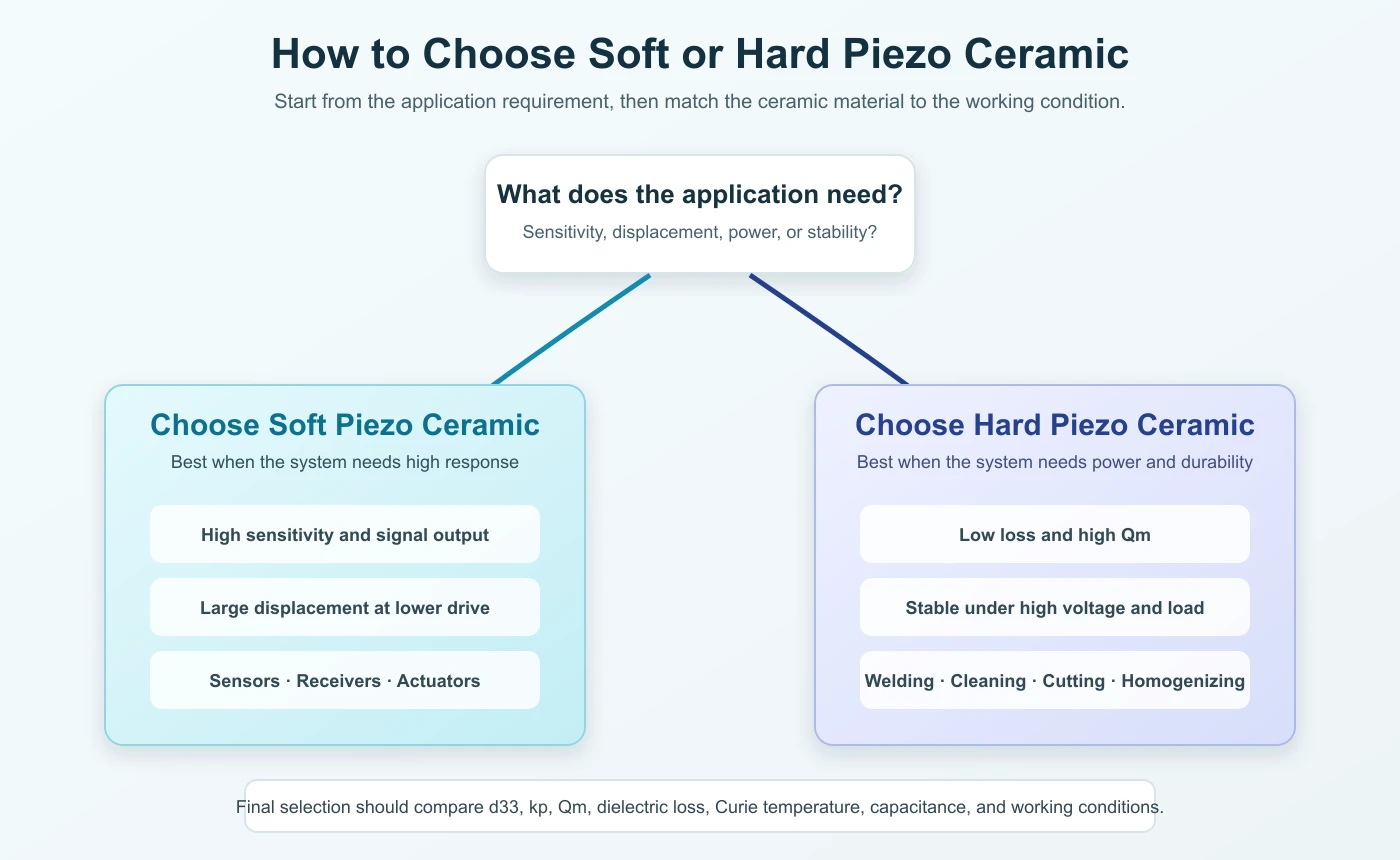
Soft piezo ceramic and hard piezo ceramic each have their own advantages. Soft ceramics provide higher sensitivity, higher dielectric constant, and larger displacement, making them suitable for sensors, receivers, actuators, and low-power transducer applications. Hard ceramics provide lower loss, higher mechanical quality factor, better stability, and stronger power handling, making them ideal for power ultrasonic transducers and industrial ultrasonic equipment.
For ultrasonic welding, cleaning, cutting, homogenization, and other high-power applications, hard piezo ceramic is often the preferred choice. For sensing, receiving, and precision low-power applications, soft piezo ceramic may deliver better performance.
By selecting the correct piezo ceramic material, manufacturers can improve ultrasonic efficiency, stability, output performance, and long-term reliability.

Leave A Comment