
Performance of PZT8 Versus PZT4 Piezoceramic Materials
PZT8 and PZT4 are two of the most widely used hard piezoceramic materials in power ultrasonic transducers. Both materials are designed for applications that require mechanical strength, stable resonance, low dielectric loss, and reliable operation under electrical and mechanical load. They are commonly used in ultrasonic welding, ultrasonic cleaning, ultrasonic cutting, sonar, underwater acoustic transmitters, and other high-power or signal-transmitting systems.
Although PZT8 and PZT4 belong to the same general category of hard piezo ceramics, their performance characteristics are not identical. Choosing between them depends on the working frequency, output requirement, preload condition, drive level, operating environment, and expected service life of the final transducer.
For manufacturers and equipment designers, understanding the difference between PZT8 and PZT4 is important because the ceramic material directly affects ultrasonic output, heating, amplitude stability, resonance behavior, and long-term reliability.
What Are PZT8 and PZT4?
PZT8 and PZT4 are both lead zirconate titanate based hard piezoceramic materials. Compared with soft piezo ceramics, hard piezoceramics generally provide lower dielectric loss, higher mechanical quality factor, better stability under high drive conditions, and stronger resistance to depolarization.
These properties make hard PZT materials suitable for power ultrasonic applications where the ceramic must operate continuously at resonance and withstand high mechanical stress.
In simple terms:
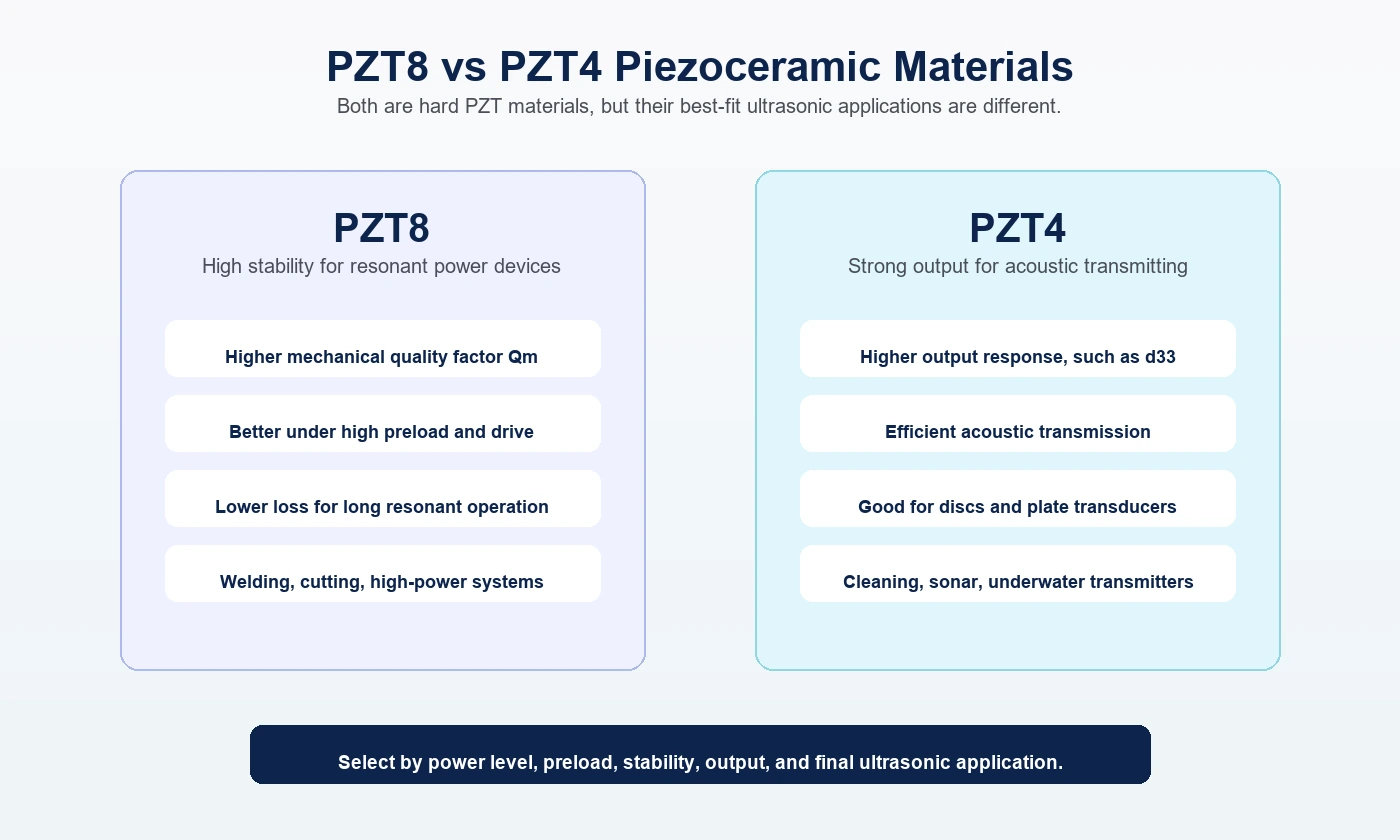
- PZT8 is often selected for resonant power devices that require high stability, high mechanical quality factor, and reliable performance under higher preload and drive levels.
- PZT4 is often selected where stronger output response and efficient acoustic transmission are important, especially in signal transmitting and underwater acoustic applications.
PZT8: Stable Performance for Resonant Power Devices
PZT8 is commonly considered the stronger choice for high-power resonant ultrasonic devices. Its main advantage is a higher mechanical quality factor, often referred to as Qm. A higher Qm means the material can store and transfer mechanical energy efficiently at resonance, helping reduce internal losses and heat generation during operation.
Because of this, PZT8 is widely used in demanding ultrasonic systems such as:
- Ultrasonic welding transducers
- Ultrasonic cutting systems
- High-power ultrasonic processors
- Heavy-duty ultrasonic horns and boosters
- Resonant devices working under high preload
- Industrial power ultrasonic equipment
PZT8 is also regarded as a harder material than PZT4 in practical transducer design. It offers better stability under higher mechanical preload and stronger electrical drive. This is important in ultrasonic welding and cutting, where the ceramic stack must maintain stable vibration while transferring high power through the transducer assembly.
For applications that require long working time, strong mechanical durability, and stable resonance performance, PZT8 is usually the preferred option.
PZT4: Strong Output for Transmitting Applications
PZT4 is also a hard piezoceramic material, but it is often chosen for applications that need strong signal output and efficient acoustic transmission. Compared with PZT8, PZT4 generally provides a higher piezoelectric charge constant such as d33, which can support stronger displacement or output under suitable conditions.
Typical PZT4 applications include:
- Ultrasonic cleaning transducers
- Sonar transmitters
- Underwater acoustic transmitters
- Signal transmitting devices
- Medium-power ultrasonic transducers
- Disc and plate ultrasonic cleaning systems
In ultrasonic cleaning systems, PZT4 piezo ceramic discs or plates are often installed at the bottom or side wall of cleaning tanks. These transducers can operate from tens of kilohertz to higher frequency ranges, depending on the cleaning requirement and tank design.
For precision cleaning in semiconductor, optical, medical, and fine mechanical manufacturing, disc and plate transducers can provide compact construction, efficient ultrasonic energy transfer, and stable cleaning performance.
Key Performance Differences
The main difference between PZT8 and PZT4 is not simply which material is better. Each material has advantages in different working conditions.
PZT8 usually provides:
- Higher mechanical quality factor
- Lower internal loss during resonant operation
- Better stability under high preload
- Better performance at higher drive levels
- Strong resistance to depolarization
- Good suitability for welding, cutting, and high-power ultrasonic systems
PZT4 usually provides:
- Higher piezoelectric output response
- Strong acoustic transmitting capability
- Good performance in ultrasonic cleaning
- Good suitability for sonar and underwater acoustic transmitters
- Effective performance in disc and plate transducer designs
In practical transducer design, the final choice should not rely on material name alone. Engineers should compare the electrical, mechanical, thermal, and acoustic requirements of the complete ultrasonic system.
Application Selection Guide
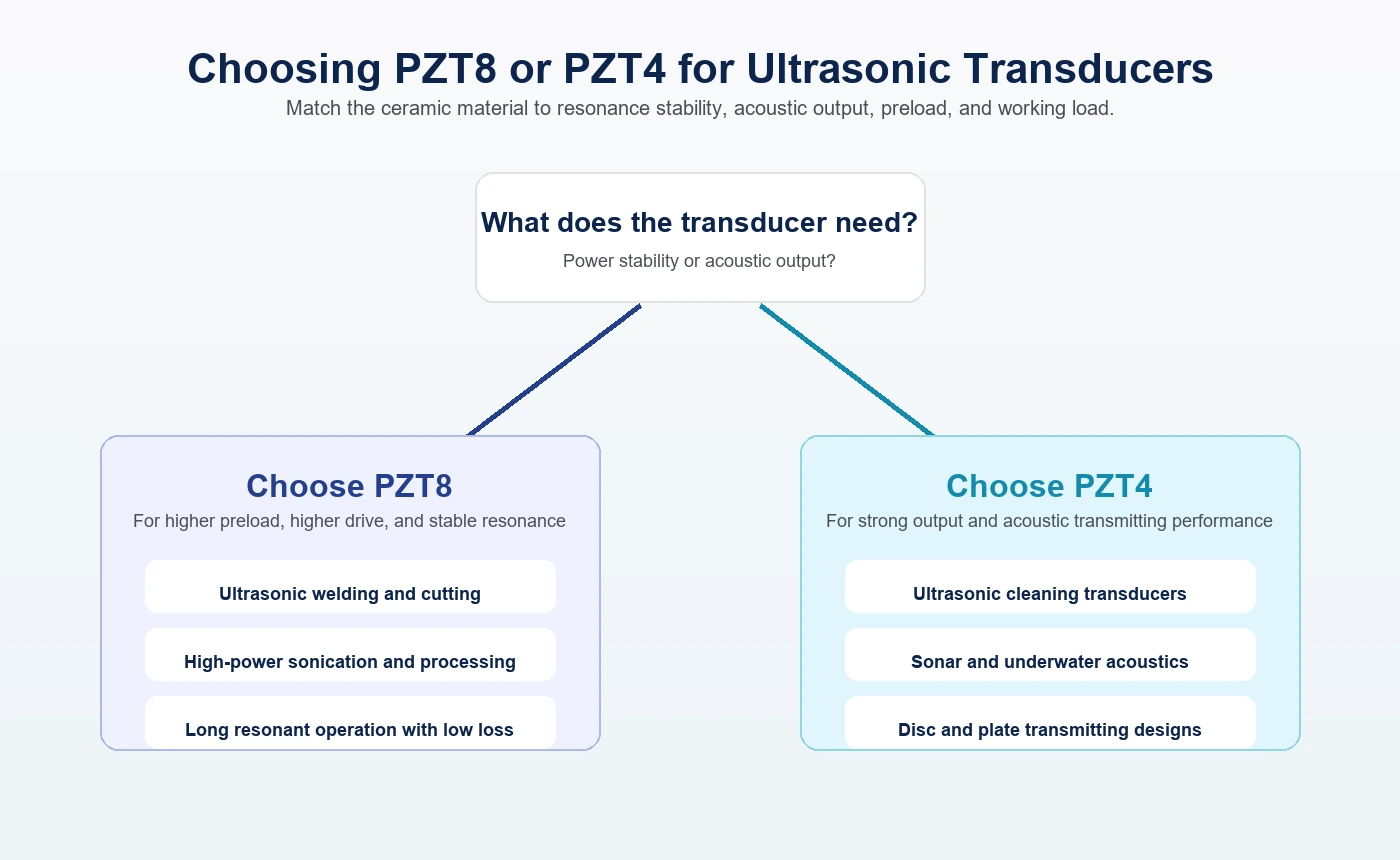
For ultrasonic welding, ultrasonic cutting, and high-power resonant devices, PZT8 is often selected because it can maintain stable operation under stronger preload and drive conditions. These applications usually require low heat generation, long service life, and high mechanical stability.
For ultrasonic cleaning, sonar transmission, and acoustic transmitting systems, PZT4 is often selected because it can provide effective output and strong acoustic conversion in suitable designs. It is commonly used in disc and plate transducers installed in cleaning tanks or acoustic transmitting assemblies.
For ultrasonic homogenizers and high-power sonication equipment, material selection depends on the required power level, working amplitude, transducer structure, and cooling condition. In many high-power systems, PZT8-type materials are preferred because stable resonance and low loss are critical during continuous operation.
Poreless Piezo Ceramic Materials
In addition to standard hard PZT materials, poreless piezo ceramic materials can be used for applications that require higher ultrasonic power density, higher mechanical strength, wider amplitude performance, low aging rate, and very low porosity.
Low porosity is important because pores can reduce mechanical strength, increase internal loss, and limit power handling capability. For demanding ultrasonic transducers, a dense ceramic structure helps improve durability and stable output.
Poreless piezoceramics can therefore be valuable in high-power ultrasonic applications where long-term reliability and consistent acoustic performance are required.
How to Choose Between PZT8 and PZT4
When selecting between PZT8 and PZT4, engineers should consider:
- Required ultrasonic power
- Resonance frequency
- Mechanical preload
- Drive voltage and current
- Expected amplitude
- Heat generation and cooling
- Continuous or intermittent operation
- Transducer shape and size
- Acoustic load and coupling condition
- Final application, such as welding, cleaning, cutting, sonar, or homogenization
If the system requires high stability, high preload, high drive level, and long-term resonant operation, PZT8 is usually the stronger choice. If the system requires strong acoustic output or transmitting performance at moderate drive conditions, PZT4 may be more suitable.
In real-world ultrasonic design, the ceramic material must also be matched with the metal parts, electrode design, bonding process, front mass, back mass, horn, generator, and operating load. A good material choice becomes truly effective only when the complete transducer is correctly designed.
PZT8 and PZT4 are both important hard piezoceramic materials for ultrasonic transducers. PZT8 is known for high mechanical quality factor, strong stability, and reliable performance in high-power resonant devices such as ultrasonic welding and cutting systems. PZT4 offers strong output response and is widely used in ultrasonic cleaning, sonar, underwater acoustic transmitters, and signal transmitting applications.
There is no single best material for every ultrasonic system. The right choice depends on the working condition and performance target of the final product.
For ultrasonic equipment manufacturers, selecting the correct piezoceramic material is a key step toward improving power efficiency, amplitude stability, heat control, acoustic output, and long-term service life.

Leave A Comment