
Determining Resonance Frequency in Piezoelectric Ceramic Elements
Resonance frequency is one of the most important parameters in the design and testing of piezoelectric ceramic elements. It directly affects energy conversion efficiency, vibration output, impedance behavior, and the final performance of ultrasonic transducers, sensors, actuators, and other piezoelectric devices.
When a piezoelectric ceramic element is driven by an AC electric field, it expands and contracts cyclically at the same frequency as the applied signal. At certain frequencies, the ceramic vibrates more easily and converts electrical energy into mechanical vibration more efficiently. This frequency region is known as resonance.
Understanding resonance frequency helps engineers select the right piezo ceramic material, optimize component dimensions, and match the ceramic element with the generator, circuit, horn, or mechanical structure used in the final system.
What Is Resonance Frequency?
The resonance frequency is the frequency at which a piezoelectric ceramic element vibrates most readily. At this point, the element can achieve strong mechanical vibration with efficient electrical-to-mechanical energy conversion.
As the driving frequency increases, the impedance of the ceramic element changes. The element first approaches a frequency where impedance reaches a minimum and admittance reaches a maximum. This point is commonly called the minimum impedance frequency, fm.
The minimum impedance frequency is closely related to:
- fr: resonance frequency
- fs: series resonance frequency
- fm: minimum impedance frequency
In practical testing, fm is often used as the measured resonance frequency because it is easy to identify on an impedance analyzer.
What Is Anti-Resonance Frequency?
As the frequency continues to increase beyond resonance, the impedance rises until it reaches a maximum. At this point, admittance reaches a minimum. This frequency is called the maximum impedance frequency, fn.
The maximum impedance frequency is closely related to:
- fa: anti-resonance frequency
- fp: parallel resonance frequency
- fn: maximum impedance frequency
The strongest operating response of the ceramic element generally occurs between fm and fn, depending on the vibration mode, load condition, and circuit design.
What Determines the Resonance Frequency?
The resonance frequency of a piezoelectric ceramic element is determined by several factors, including:
- Ceramic material composition
- Element shape
- Element thickness
- Diameter or length
- Vibration mode
- Electrode design
- Boundary and mounting conditions
- Mechanical load
In general, for elements with the same shape and material, a thicker ceramic element has a lower resonance frequency than a thinner element. This is why the dimensions of piezo ceramic rings, discs, plates, and rods must be carefully designed according to the target operating frequency.

Measuring Resonance and Anti-Resonance
The minimum impedance frequency fm and maximum impedance frequency fn can be measured using an impedance analyzer or a frequency sweep test system.
During the test, the instrument scans a frequency range and records impedance or admittance. The resonance frequency is identified at the lowest impedance point, while the anti-resonance frequency is identified at the highest impedance point.
Typical measurement steps include:
- Place the ceramic element or transducer in the test fixture.
- Sweep the frequency across the expected operating range.
- Identify the minimum impedance point, fm, as the resonance frequency.
- Identify the maximum impedance point, fn, as the anti-resonance frequency.
- Use fm and fn to evaluate electromechanical coupling and material performance.
For production testing, parameters such as capacitance, impedance, resonance frequency, anti-resonance frequency, bandwidth, dielectric loss, and mechanical quality factor are often measured together.
Using fm and fn to Evaluate Coupling Factor
The electromechanical coupling factor, k, describes how effectively a piezoelectric ceramic converts energy between electrical and mechanical forms. The measured values of fm and fn can be used to estimate coupling factors for different vibration modes and component shapes.
Common examples include:
- k31 for plate vibration modes
- kp for radial vibration of discs
- k33 for longitudinal vibration of rods
The exact formula depends on the geometry and vibration mode. This is why it is important to identify the component shape and polarization direction before calculating or comparing coupling factors.
Why Resonance Frequency Matters in Ultrasonic Applications
For ultrasonic systems, resonance matching is critical. If the piezoelectric ceramic element, transducer structure, horn, and generator are not properly matched, the system may show low output, unstable vibration, overheating, high impedance, or reduced efficiency.
Accurate resonance frequency testing helps engineers:
- Select suitable piezo ceramic dimensions
- Match ceramics with ultrasonic transducer structures
- Tune ultrasonic generators and horns
- Improve vibration amplitude and output efficiency
- Reduce heat generation and energy loss
- Check production consistency
- Identify defective or unstable components
In high-power ultrasonic cleaning, welding, cutting, and homogenization systems, resonance stability is especially important for reliable long-term operation.
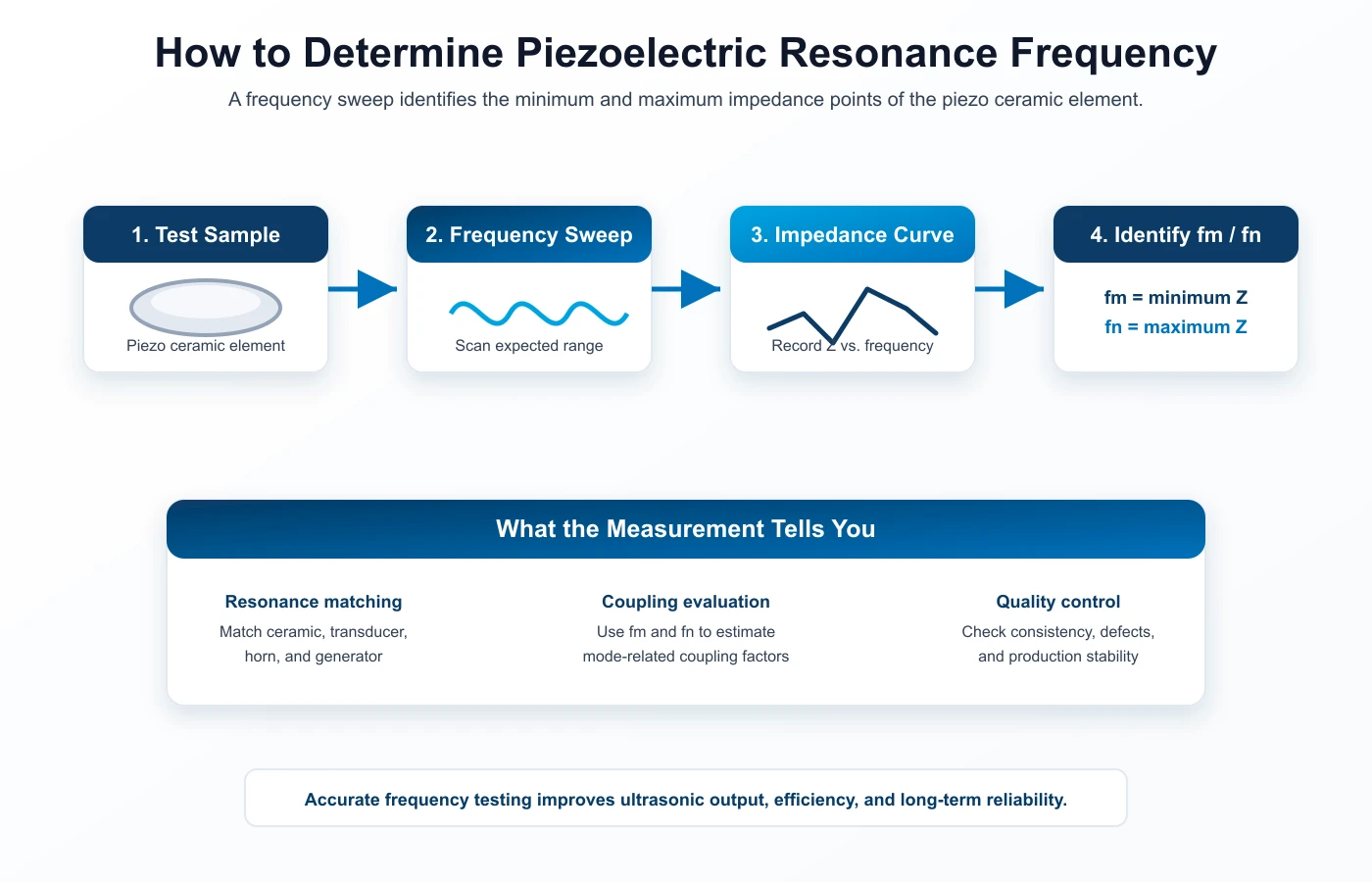
Determining resonance frequency is a fundamental step in piezoelectric ceramic design, testing, and application. The minimum impedance frequency fm indicates the resonance point where the ceramic vibrates efficiently, while the maximum impedance frequency fn indicates the anti-resonance point.
By measuring fm and fn, engineers can evaluate impedance behavior, calculate coupling-related parameters, and optimize piezoelectric components for sensors, actuators, ultrasonic transducers, and high-power ultrasonic systems.
For any precision piezoelectric or ultrasonic application, accurate resonance frequency measurement is essential for stable performance, efficient energy conversion, and consistent product quality.

Leave A Comment