
The Function of the Ultrasonic Transducer
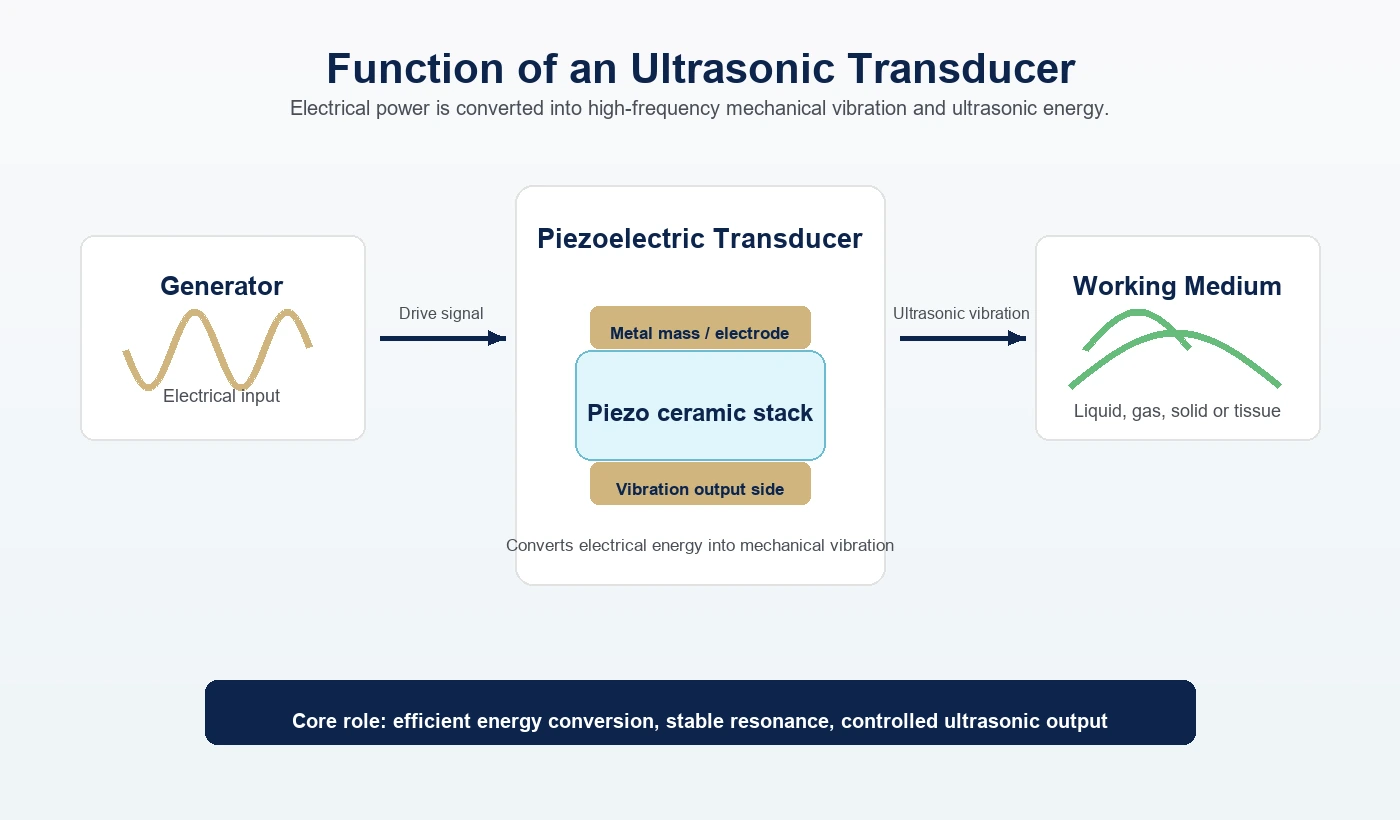
An ultrasonic transducer is the core energy conversion component in an ultrasonic system. Its main function is to convert electrical power into high-frequency mechanical vibration, which is then transmitted into a tool head, liquid, gas, solid structure, or biological medium. In simple terms, the ultrasonic transducer turns electrical energy into usable ultrasonic energy.
During this conversion process, most of the input energy is transferred outward as vibration or acoustic energy, while a small part is consumed by the transducer itself as heat and internal loss. A well-designed transducer should therefore provide efficient energy conversion, stable resonance, low heat generation, and reliable long-term operation.
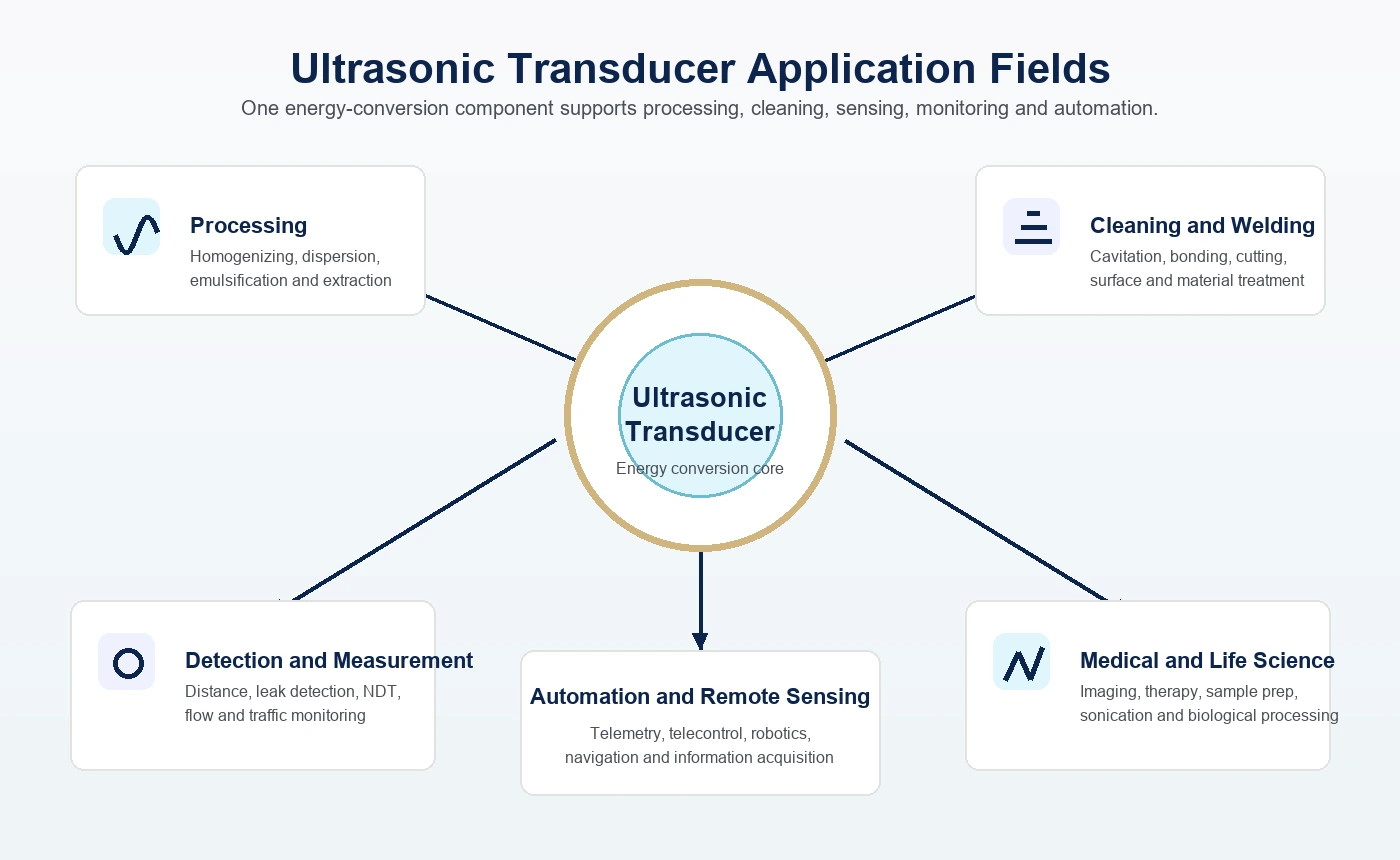
Ultrasonic transducers are widely used in industry, agriculture, transportation, medical technology, laboratory processing, automation, environmental monitoring, and defense-related systems. According to their function, they can be used for ultrasonic processing, cleaning, detection, monitoring, telemetry, remote control, imaging, and measurement.
How an Ultrasonic Transducer Works
Most industrial ultrasonic transducers use piezoelectric ceramic elements as the active material. When an alternating electrical signal is applied to the piezo ceramic stack, the ceramic expands and contracts at high frequency. This movement creates mechanical vibration, which is amplified and transmitted through the transducer structure.
A typical ultrasonic transducer system includes:
- Piezoelectric ceramic elements
- Front and back metal masses
- Electrodes and insulation parts
- Bolt or preload structure
- Horn, probe, tank plate, or acoustic matching layer
- Ultrasonic generator or driving circuit
The generator provides electrical energy at a target frequency. The transducer converts this electrical input into mechanical vibration. The horn, probe, tank, or radiating surface then delivers the ultrasonic energy to the working medium.
The final effect depends on frequency, power, amplitude, transducer design, acoustic coupling, and the medium being processed.
Main Functions of Ultrasonic Transducers
Ultrasonic transducers can be divided into several functional categories.
Power ultrasonic transducers are designed to deliver high mechanical energy. They are used in ultrasonic cleaning, welding, cutting, homogenization, dispersion, emulsification, extraction, and other processing applications.
Detection ultrasonic transducers are designed to transmit and receive ultrasonic signals. They are used for distance measurement, non-destructive testing, leak detection, flow measurement, imaging, traffic monitoring, and automatic sensing.
Ultrasonic imaging and measurement transducers are used where precise signal detection is required, such as medical imaging, industrial inspection, and robotic perception.
Although these applications are different, the basic principle is the same: electrical signals and mechanical vibration are converted into each other through piezoelectric materials.
Industrial Ultrasonic Processing
In industrial production, ultrasonic transducers are often used to transfer high-frequency vibration into liquids, solids, or tools. This vibration can produce cavitation, microstreaming, impact, friction, or localized mechanical stress, depending on the application.
Common industrial uses include:
- Ultrasonic cleaning
- Ultrasonic welding
- Ultrasonic cutting
- Ultrasonic homogenization
- Ultrasonic dispersion
- Ultrasonic emulsification
- Ultrasonic extraction
- Ultrasonic degassing
For ultrasonic homogenizers and sonicators, the transducer converts electrical energy into vibration and delivers it through a probe into the liquid medium. The resulting cavitation and micro-mechanical effects help break particles, disperse materials, emulsify liquids, disrupt cells, or accelerate extraction.
For ultrasonic cleaning, transducers are mounted on the cleaning tank or immersed in the liquid. The ultrasonic vibration creates cavitation bubbles that collapse near the surface of the parts, removing dirt, oil, particles, and contaminants.
Detection, Measurement, and Monitoring
Ultrasonic transducers are also widely used for sensing and measurement. In these applications, the transducer may transmit an ultrasonic pulse, receive an echo, or perform both functions.
For distance measurement, a transducer sends an ultrasonic pulse toward an object. The reflected echo is received by the same or another transducer. By measuring the time between transmission and reception, the system can calculate distance.
For traffic monitoring, ultrasonic transducers can be used to detect vehicles, count traffic flow, monitor reversing distance, or support collision avoidance systems. Similar pulse-echo technology is used in parking assistance and industrial object detection.
For leak detection and non-destructive testing, ultrasonic transducers can detect sound signals, reflected waves, or changes in acoustic transmission. In pressure systems, leaks often generate high-frequency noise that can be detected ultrasonically. In closed systems, an ultrasonic source can be placed inside while a receiving transducer detects leakage points from outside.
For flow measurement, ultrasonic transducers can measure gas or liquid flow without blocking the fluid path. This non-contact or non-intrusive advantage is especially useful in chemical, process, water treatment, and industrial pipeline applications.
Medical, Biological, and Life Science Applications
Ultrasonic transducers are also used in medical, biological, and life science fields. Depending on the design and power level, they may support imaging, therapy, measurement, or sample processing.
In medical and aesthetic systems, ultrasonic energy can be applied to tissue treatment, diagnostic imaging, or body-contouring equipment. In electronic blood pressure measurement and other medical instruments, ultrasonic or pressure-related sensing principles can help detect physiological signals.
In biological and laboratory applications, ultrasonic transducers are used in homogenizers and sonicators for cell disruption, sample preparation, emulsification, dispersion, extraction, and degassing.
In agricultural research, properly controlled ultrasonic treatment may be used for seed treatment, biological stimulation, or process studies. The exact effect depends strongly on frequency, intensity, treatment time, medium, and biological conditions.
Telemetry, Remote Control, and Information Acquisition
Ultrasonic transducers can also be used for remote signaling and information acquisition. In environments where direct operation is difficult or unsafe, ultrasonic transmission can support remote sensing, signal communication, or control functions.
Robotic systems may use small ultrasonic transducer arrays to measure distance, identify obstacles, and support navigation. Because ultrasonic waves can detect objects without direct contact, they are useful in automation, guided vehicles, smart equipment, and environmental perception.
In harsh, toxic, radioactive, or inaccessible environments, ultrasonic sensing can help collect information while keeping operators away from dangerous areas.
Key Design Considerations
The performance of an ultrasonic transducer depends on both material selection and structural design. Important factors include:
- Piezo ceramic material
- Resonance frequency
- Power capacity
- Mechanical preload
- Amplitude requirement
- Heat dissipation
- Horn or probe design
- Acoustic matching
- Working medium
- Continuous or intermittent operation
- Generator matching and control
For power applications, stability, low loss, high mechanical strength, and heat control are critical. For detection applications, sensitivity, bandwidth, signal-to-noise ratio, and acoustic matching are often more important.
This is why different ultrasonic systems require different transducer designs. A cleaning transducer, welding transducer, homogenizer transducer, flow measurement transducer, and imaging transducer may all use piezoelectric ceramics, but their structures and performance targets are very different.
The function of an ultrasonic transducer is to convert electrical energy into ultrasonic mechanical vibration, and in some systems to convert received ultrasonic vibration back into electrical signals. This energy conversion is the foundation of ultrasonic cleaning, welding, cutting, homogenization, detection, imaging, flow measurement, distance measurement, and many other applications.
For ultrasonic equipment manufacturers, the transducer determines much of the final system performance. A properly designed transducer can improve energy efficiency, output stability, process reliability, measurement accuracy, and service life.
By selecting the right piezo ceramic material, resonance structure, and application-specific design, ultrasonic transducers can deliver reliable performance across industrial, laboratory, medical, automation, and sensing fields.

Leave A Comment