
Piezo Ceramics for Sensor Technology
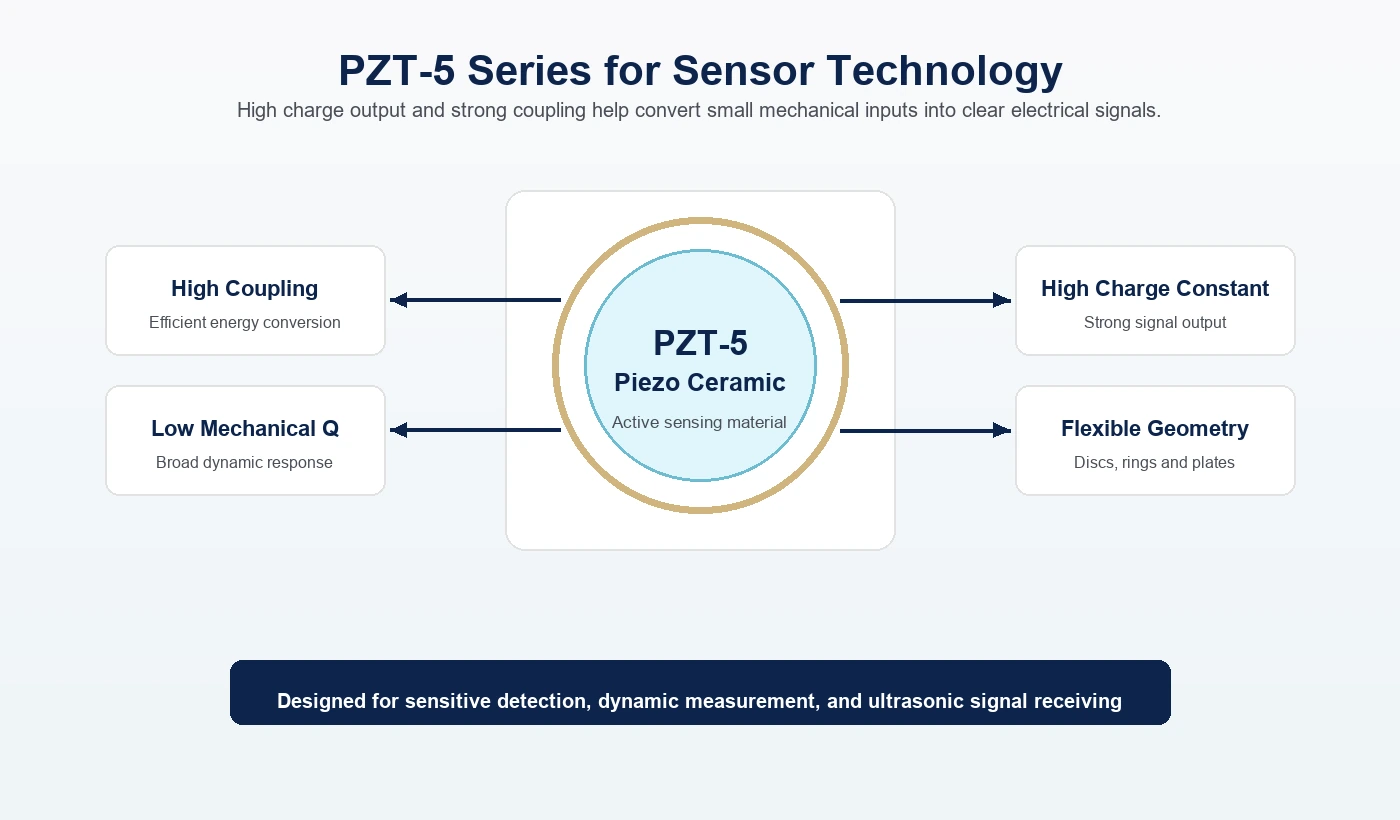
Why Piezo Ceramics Are Used in Sensors
Piezo ceramics operate through the direct piezoelectric effect. When a mechanical force acts on the ceramic, the internal electric charge distribution changes and an electrical signal is generated. This signal can then be measured, amplified, filtered, and converted into useful data.
In many sensor systems, the same piezo ceramic element can also work as a transmitter and receiver. For example, an ultrasonic distance sensor can emit an ultrasonic pulse and then receive the reflected echo. By measuring the travel time of the ultrasonic wave, the system can calculate distance or detect the presence of an object.
Compared with many other sensing materials, piezo ceramics offer several important advantages:
- High sensitivity to dynamic force and vibration
- Fast response to short pulses and high-frequency signals
- Compact size and flexible geometry
- Good stability in industrial environments
- Strong compatibility with ultrasonic transmission and receiving
- Reliable performance in long-term sensing applications
These advantages make piezo ceramics suitable for both simple detection functions and more advanced measurement systems.
Typical Piezo Ceramic Sensor Applications
Piezo ceramic components can be designed as discs, rings, rectangular plates, square plates, perforated rings, and other custom shapes. The final geometry depends on the sensor structure, frequency requirement, mounting method, and working environment.
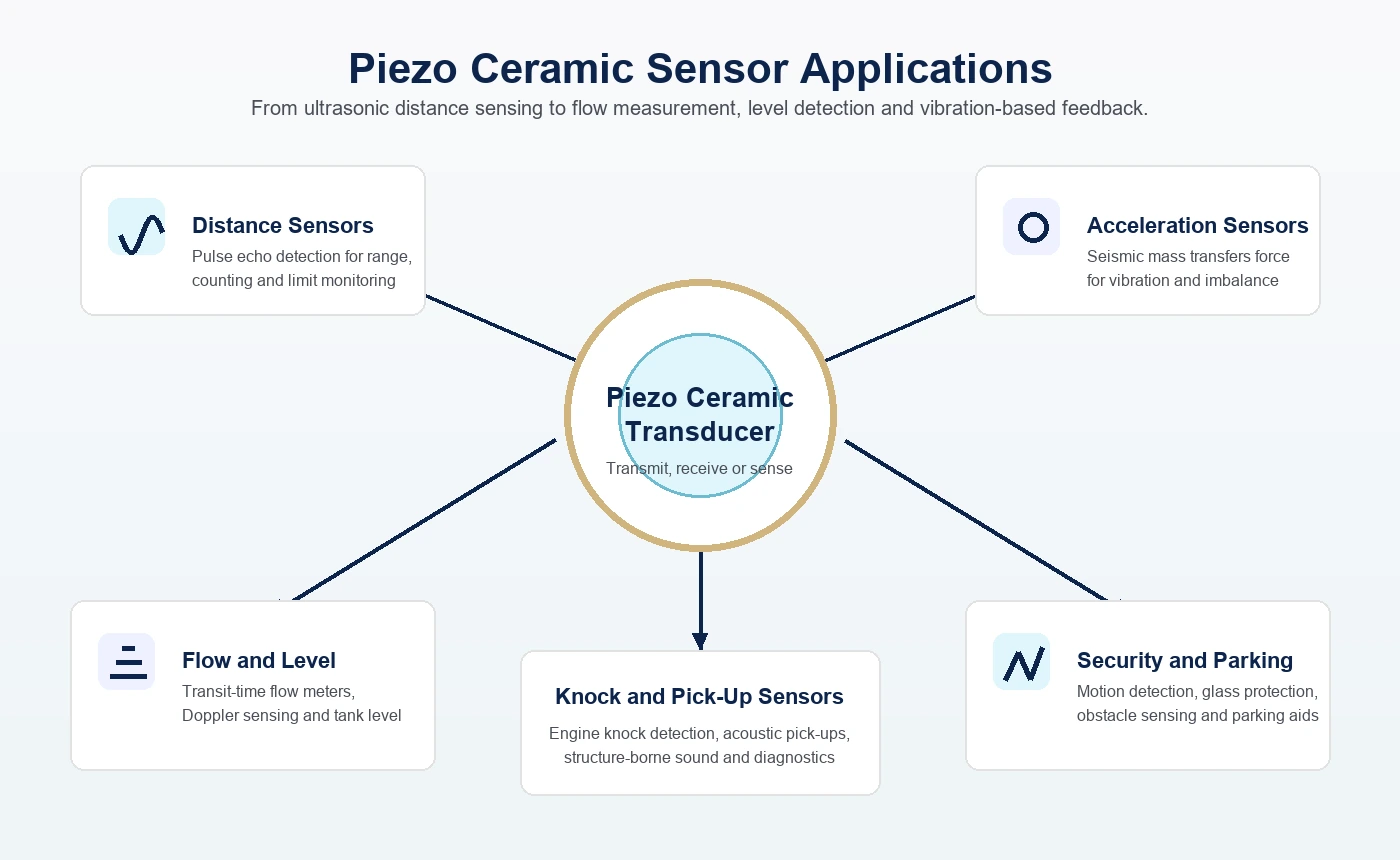
Common applications include:
- Distance sensors
- Acceleration sensors
- Flow rate measurement
- Burglar alarm systems
- Parking aids
- Level sensors
- Knock sensors
- Ultrasonic air transducers
- Property protection systems
- Sound pick-ups for musical instruments
Each application uses the same basic piezoelectric principle, but the mechanical design and signal processing method can be very different.
Ultrasonic Distance Sensors
In an ultrasonic distance sensor, a piezo ceramic disc sends a short ultrasonic pulse toward the target object. The sound wave is reflected by the object and received again by the same or another piezo ceramic element. The sensor calculates distance by measuring the time between transmission and echo reception.
The operating frequency depends on the required range and resolution. Higher frequencies generally provide better resolution but shorter measuring range. Lower frequencies can support longer range, but with lower resolution. In many industrial distance sensors, directed ultrasonic radiation is preferred because it allows the sensor to focus on a specific detection area.
Typical measurable distances for many air ultrasonic systems are approximately 0.25 m to 10 m, depending on the transducer design, frequency, target surface, and operating environment.
These sensors are widely used in industrial automation for distance measurement, object counting, limit monitoring, and presence detection.
Acceleration Sensors
Piezo ceramic acceleration sensors convert dynamic mechanical force into an electrical signal. In many designs, a seismic mass is coupled to the piezo ceramic element. When the system accelerates, the mass applies force to the ceramic, and the ceramic generates a corresponding signal.
This principle is used in vibration monitoring, dynamic balancing machines, machinery diagnostics, and other systems where fast detection of acceleration or imbalance is required. For example, in wheel balancing equipment, the piezo ceramic sensor can help detect and quantify imbalance quickly so that correction weights can be positioned accurately.
Suitable ceramic geometries may include round discs, rectangular plates, or rings, depending on the required sensitivity and mounting structure.
Ultrasonic Flow Rate Measurement
Piezo ceramic transducers are also used in ultrasonic flow meters. Two common measurement principles are Doppler measurement and transit-time measurement.
In Doppler flow measurement, the transducer sends ultrasonic waves into a liquid. The waves are reflected by particles or bubbles in the flow. The frequency shift between the transmitted and reflected waves is used to estimate flow velocity.
In transit-time flow measurement, two piezo ceramic transducers are positioned on the pipe or tube. They send ultrasonic pulses both with and against the direction of flow. Since the flow speed affects the travel time of the sound wave, the system can calculate flow velocity from the time difference.
Transit-time measurement is widely used because it can measure liquids and gases and is less dependent on the sound speed of the medium when properly designed.
Security, Property Protection, and Parking Aids
Piezo ceramic transducers are used in burglar alarm systems and property protection devices. In room protection, ultrasonic motion sensors transmit ultrasonic waves and monitor reflected signals. Movement inside the protected area changes the echo pattern and triggers detection.
For property protection, small piezo ceramic plates can be mounted on windows, glass panels, or other protected surfaces. Vibrations caused by cutting, impact, or intrusion tools can be detected as electrical signals, allowing the system to respond early.
Parking aids use a similar ultrasonic pulse-echo principle. A piezo ceramic transducer emits a short ultrasonic pulse, receives the echo from an obstacle, and calculates distance from the travel time. This technology is widely used in passenger vehicles, trucks, reversing assistance, and loading ramp distance detection.
Level Sensors
Piezo ceramics can be used in both airborne ultrasonic level measurement and immersed level detection.
In airborne ultrasonic level measurement, a transducer sends ultrasonic pulses toward the surface of a liquid or solid material. The reflected echo is used to calculate the distance to the surface and therefore the fill level.
In immersed transducer measurement, a piezo ceramic element can excite a metal tuning fork or another resonant structure. When the structure is immersed in liquid, powder, or another material, its resonant frequency changes. The electronics detect this change and determine whether the level has reached a specified point.
This method is often used for reliable point-level detection in tanks and containers.
Knock Sensors and Ultrasonic Air Transducers
Automotive knock sensors often use piezo ceramic rings, seismic masses, and electrodes. When engine vibration occurs, the seismic mass applies force to the piezo ceramic ring. The ceramic generates a signal over a wide frequency range, allowing the engine control system to identify knock and adjust ignition timing.
This helps engine management systems operate close to the knocking limit while improving efficiency and reducing fuel consumption.
Ultrasonic air transducers also use piezo ceramic elements to transmit and receive ultrasonic pulses in air. They are used in equipment engineering, plant construction, object detection, distance measurement, and process automation.
Sound Pick-Ups
Small piezo ceramic plates are also used as vibration pick-ups in musical instruments. When installed in a guitar bridge or similar structure, the ceramic element detects string vibration and converts it into an electrical signal. The signal can then be amplified, recorded, or processed electronically.
This same vibration sensing principle can be applied to many acoustic instruments and other structure-borne sound detection systems.
Material and Design Considerations
Selecting the correct piezo ceramic material is essential for sensor performance. Engineers should consider:
- Sensitivity and charge output
- Coupling factor
- Mechanical quality factor
- Frequency range
- Ceramic shape and size
- Mounting and preload condition
- Electrode design
- Environmental resistance
- Signal conditioning requirements
For many sensor applications, PZT-5 series materials and related formulations such as PZT-51, PSnN-5, and PLiS-51 are used because they provide strong sensitivity and stable signal conversion. For higher-power or harsh operating conditions, other formulations may be selected according to the required durability and operating environment.
Conclusion
Piezo ceramics are important materials for modern sensor technology. Their ability to convert mechanical movement, vibration, force, pressure, and ultrasonic waves into electrical signals makes them ideal for dynamic measurement and feedback systems.
From ultrasonic distance sensors and flow meters to acceleration sensors, level detection, automotive knock sensors, security systems, and acoustic pick-ups, piezo ceramic components provide compact, sensitive, and reliable performance.
For sensor manufacturers and equipment designers, choosing the right piezo ceramic material, geometry, and transducer structure is key to improving measurement accuracy, signal quality, response speed, and long-term reliability.

Leave A Comment