
Piezoceramic Applications
Piezoceramic materials are functional ceramic materials that can convert mechanical energy into electrical energy and electrical energy into mechanical vibration. This unique electromechanical conversion capability makes piezoceramics essential in sensors, actuators, ultrasonic transducers, medical devices, industrial equipment, automotive systems, and many precision electronic products.
Among piezoelectric materials, PZT, or lead zirconate titanate, is one of the most widely used because it offers strong piezoelectric performance, stable processing characteristics, and flexible design options. PZT ceramics can be manufactured into rings, discs, plates, tubes, hemispheres, spheres, and customized shapes for different applications.
How Piezoceramics Work
Piezoceramics work through two related effects.
The direct piezoelectric effect occurs when mechanical pressure, vibration, or deformation generates an electrical charge. This makes piezoceramics useful for sensors, receivers, accelerometers, vibration monitoring, and acoustic detection.
The inverse piezoelectric effect occurs when an applied electrical signal causes the ceramic to deform or vibrate. This makes piezoceramics useful for actuators, ultrasonic transducers, buzzers, precision positioning devices, and high-power ultrasonic systems.
Because one material can support both sensing and driving functions, piezoceramics are highly versatile in modern electronic and ultrasonic technology.
Main Application Categories
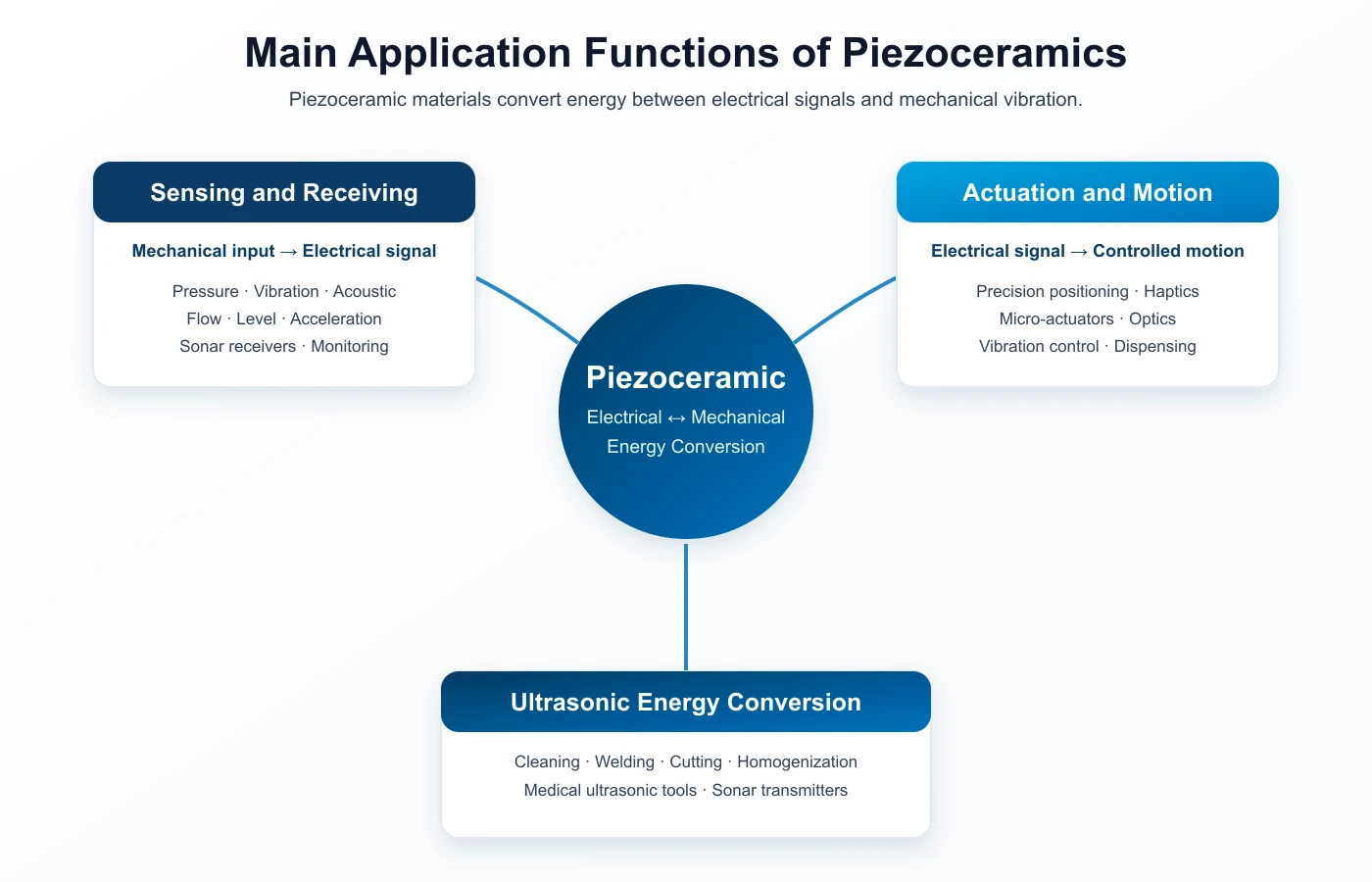
Piezoceramic applications can generally be divided into three major categories: sensing, actuation, and ultrasonic energy conversion.
1. Sensors and Receivers
In sensing applications, piezoceramics convert mechanical signals into electrical signals. They can detect pressure, acceleration, vibration, sound, impact, flow, and structural changes.
Typical applications include:
- Vibration sensors
- Pressure sensors
- Accelerometers
- Acoustic receivers
- Flow and level sensors
- Bubble detection
- Machine vibration monitoring
- Automotive knock sensors
- Underwater acoustic receivers
Soft piezoceramic materials are often selected for sensing applications because they provide high sensitivity and strong signal response.
2. Actuators and Precision Motion
In actuator applications, piezoceramics convert electrical signals into controlled mechanical displacement. Although the movement is small, the response is fast, accurate, and repeatable.
Typical applications include:
- Precision positioning stages
- Micro-actuators
- Optical adjustment systems
- Scanning probe microscopy
- Inkjet and dispensing systems
- Haptic feedback components
- Adaptive structures and active vibration control
Piezoceramic actuators are especially useful where compact size, fast response, and precise motion control are required.
3. Ultrasonic Transducers and Power Ultrasonics
Piezoceramics are the core energy-conversion elements in ultrasonic transducers. When driven at ultrasonic frequency, the ceramic element vibrates and transfers mechanical energy into a tool, horn, liquid, or acoustic medium.
Typical applications include:
- Ultrasonic cleaning
- Ultrasonic welding
- Ultrasonic cutting
- Ultrasonic homogenization and sonication
- Sonochemistry
- Underwater sonar transmitters
- Ultrasonic medical tools
- Dental scaling
- Phacoemulsification
- Tissue treatment and high-intensity focused ultrasound
For high-power ultrasonic systems, hard piezoceramic materials such as PZT4 and PZT8 are commonly used because they offer lower dielectric loss, higher mechanical quality factor, better stability, and stronger resistance to high drive conditions.
Industrial and Commercial Applications
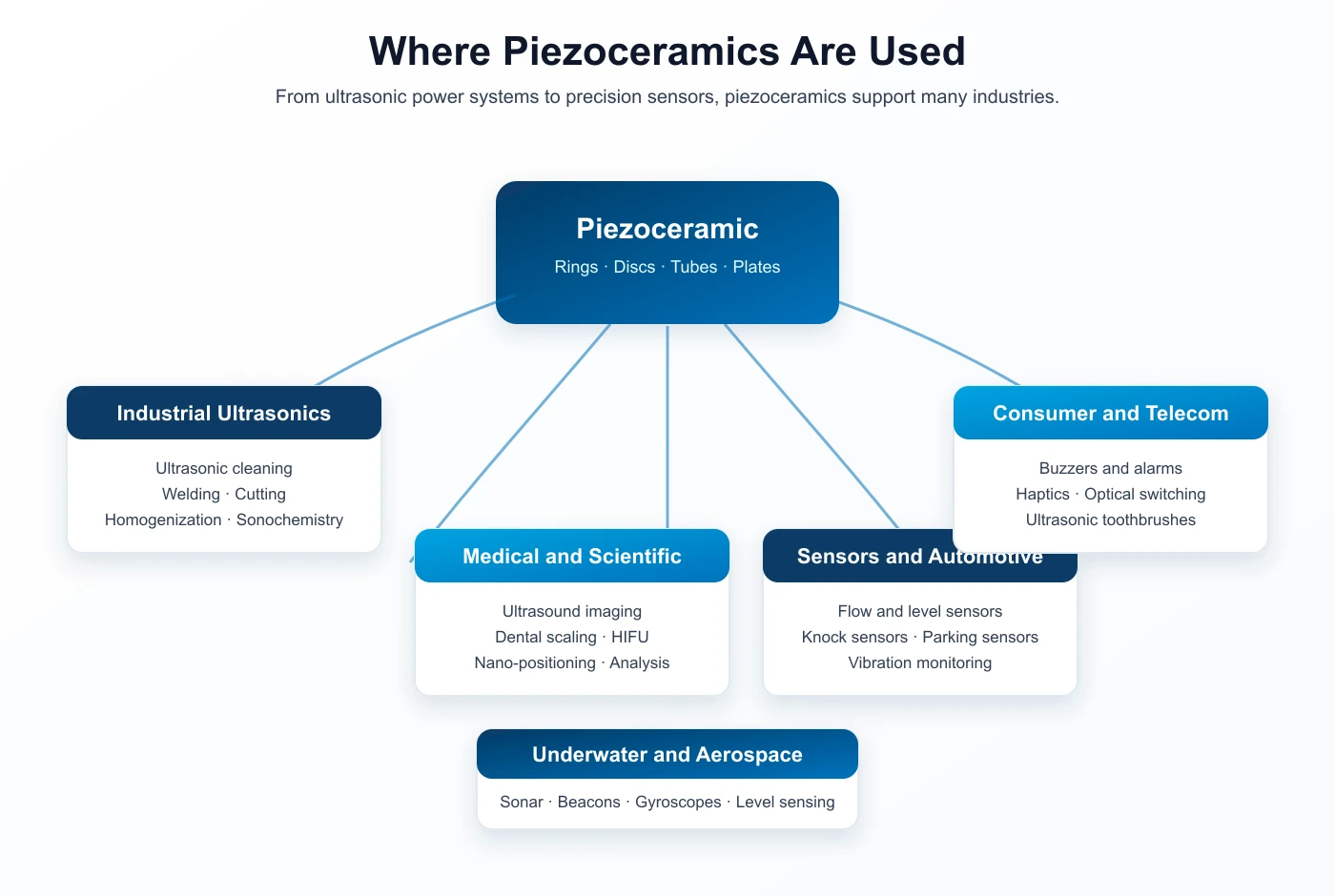
In industrial and commercial systems, piezoceramics are widely used to improve process efficiency, measurement reliability, and mechanical performance.
Common examples include:
- Flow and level measurement
- Ultrasonic cleaning tanks
- Plastic welding equipment
- Fabric welding and sewing systems
- Rotary ultrasonic cutting systems
- Solder dispensing
- Intrusion alarms
- Chemical mixing and sonochemistry
- Equipment condition monitoring
These applications benefit from the fast response, compact structure, and efficient energy conversion of piezoceramic components.
Medical and Scientific Applications
Piezoceramics are also important in medical and scientific fields. Their ability to generate and receive ultrasonic waves makes them suitable for imaging, therapy, measurement, and precision motion.
Common examples include:
- Doppler blood flow measurement
- Medical ultrasound imaging
- High-intensity focused ultrasound
- Dental cleaning devices
- Ophthalmic surgical tools
- Tissue ablation equipment
- Medication delivery systems
- Laboratory analytical tools
- Nano-positioning platforms
In these applications, material consistency, frequency stability, and precise dimensional control are especially important.
Consumer, Automotive, and Telecommunications Applications
Piezoceramics are also found in everyday products and advanced electronic systems.
Common examples include:
- Ultrasonic toothbrushes
- Jewelry and contact lens cleaners
- Buzzers and alarms
- Mobile device haptics
- Camera autofocus modules
- Touchscreen feedback
- Parking and collision sensors
- Power seat controls
- Optical switching components
- Compact acoustic devices
These products take advantage of the compact size, fast response, and efficient electromechanical conversion of piezoceramic materials.
Choosing the Right Piezoceramic Material
Different applications require different piezoceramic properties. Important selection factors include:
- Piezoelectric charge constant
- Electromechanical coupling coefficient
- Mechanical quality factor
- Dielectric constant
- Dielectric loss
- Curie temperature
- Resonance frequency
- Capacitance
- Shape and size
- Drive voltage and power level
- Operating environment
For sensing and receiving applications, high sensitivity and permittivity are often important. For high-power ultrasonic applications, low loss, high Qm, stable resonance, and strong mechanical durability are usually more important.
Summary
Piezoceramic materials are used across a broad range of technologies because they can efficiently convert energy between electrical and mechanical forms. From sensors and actuators to ultrasonic cleaning, welding, cutting, homogenization, sonar, medical devices, automotive systems, and consumer electronics, piezoceramics provide compact, reliable, and high-performance solutions.
By selecting the right material composition, shape, electrode, and design, manufacturers can optimize piezoceramic components for sensitivity, power output, stability, precision, and long-term reliability.

Leave A Comment