
Piezoelectric Ceramic as an Electronic Sounding Element
Piezoelectric ceramic is widely used as an electronic sounding element in compact acoustic devices. Because of its simple structure, low power consumption, thin profile, and reliable electro-acoustic conversion, it has become an important component in buzzers, alarms, electronic watches, instruments, timers, toys, handheld devices, and many other electronic products.
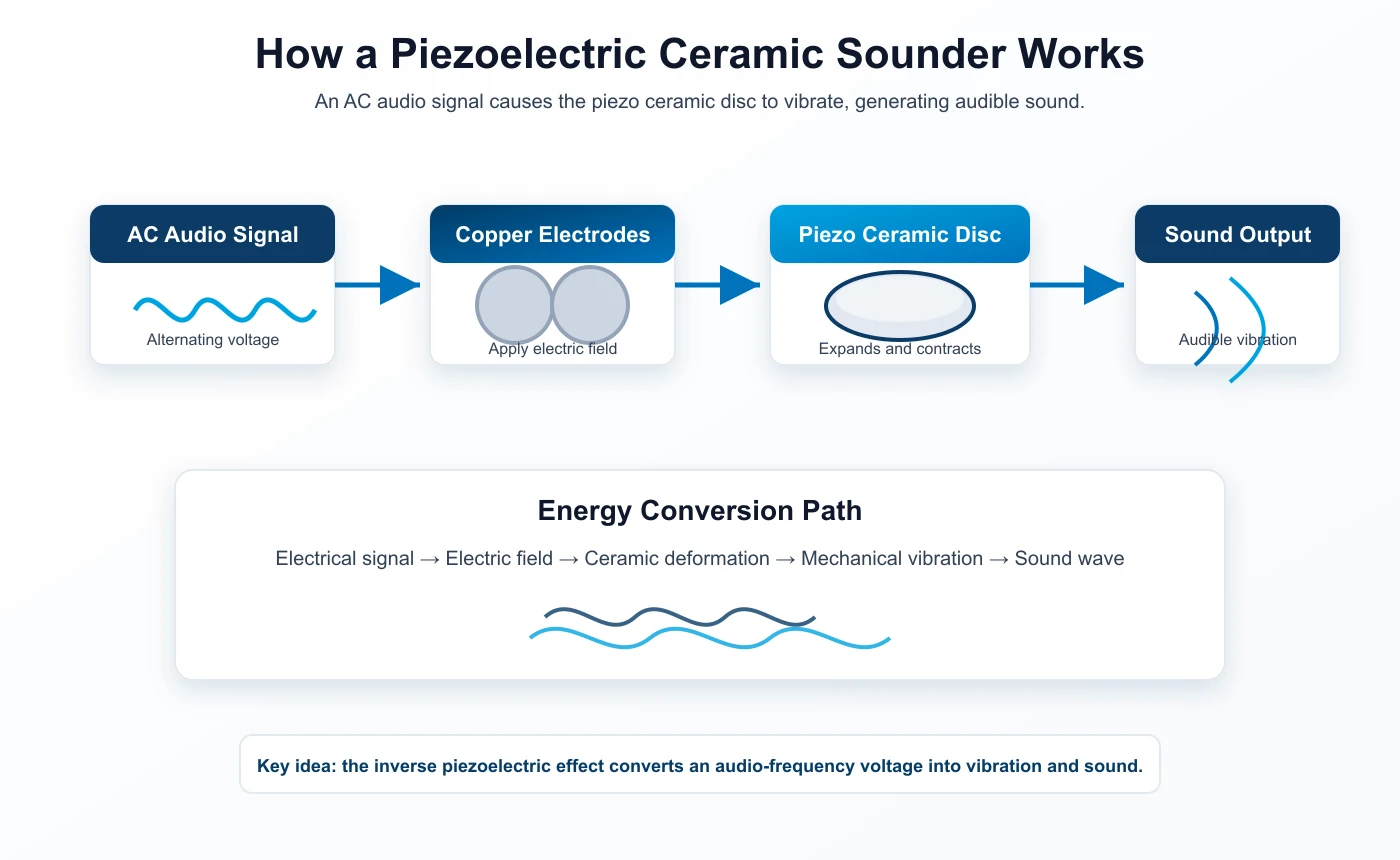
Unlike electromagnetic speakers that rely on coils and magnets, a piezoelectric ceramic sounding element uses the inverse piezoelectric effect. When an alternating audio signal is applied to the electrodes of the ceramic element, the ceramic expands and contracts at the same frequency. This rapid mechanical vibration drives the surrounding air and produces sound.
Basic Structure of a Piezoelectric Ceramic Sounding Element
A typical piezoelectric ceramic sounding element consists of a piezoelectric ceramic disc placed between two metal electrodes, commonly copper electrodes. The electrodes are connected to an audio-frequency electrical signal. When the signal changes polarity, the ceramic material deforms repeatedly, creating vibration.
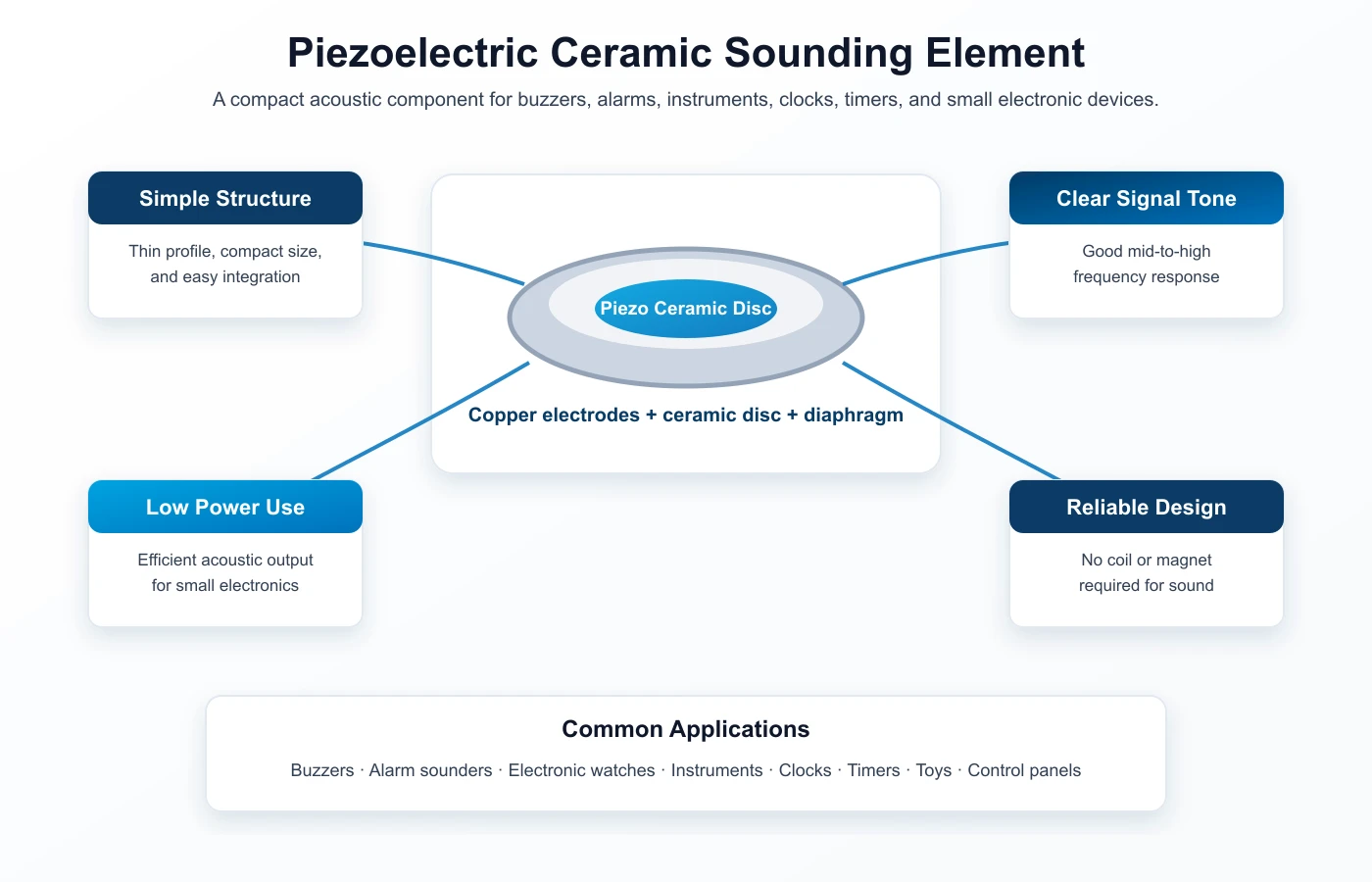
In many buzzer designs, the ceramic disc is bonded to a metal diaphragm. The diaphragm amplifies the vibration of the ceramic element and improves acoustic output. This simple and compact structure makes piezoelectric sounders suitable for small devices where space, cost, and power consumption are important.
How Piezoelectric Ceramic Produces Sound
The working principle is based on electromechanical conversion. When voltage is applied to a poled piezoelectric ceramic, the internal electric field causes a small dimensional change in the material. If the applied voltage is an AC audio signal, this dimensional change occurs repeatedly at the signal frequency.
As the ceramic vibrates, it transfers mechanical motion to the attached diaphragm or directly to the surrounding air. When the vibration frequency falls within the audible range, the device produces a sound that can be used for alerts, alarms, beeps, and signal tones.
In simple terms:
- Electrical signal is applied to the electrodes.
- The piezoelectric ceramic expands and contracts.
- Mechanical vibration is generated.
- The diaphragm or ceramic surface moves air.
- Audible sound is produced.
Advantages of Piezoelectric Ceramic Sounders
Piezoelectric ceramic sounders offer several advantages for electronic product design:
- Compact and lightweight structure
- Low power consumption
- Fast response
- Simple drive circuit
- Low manufacturing cost
- Good output at mid-to-high frequencies
- Thin profile for space-limited devices
- Reliable operation with no coil or magnet structure
These advantages make piezoelectric ceramic sounders especially useful in portable electronics, alarms, control panels, meters, and small signal devices.
Common Applications
Piezoelectric ceramic sounding elements are widely used in everyday electronic devices and industrial products. Typical applications include:
- Electronic buzzers
- Alarm sounders
- Toys and learning devices
- Electronic watches and clocks
- Timers
- Measuring instruments
- Household appliances
- Handheld electronic products
- Control panels and warning devices
- Small acoustic signal modules
With the development of thinner and more energy-efficient devices, piezoelectric ceramic sounders continue to play an important role in compact acoustic components.
Material Requirements for Better Sounding Performance
The performance of a piezoelectric ceramic sounding element depends strongly on the ceramic material and structural design. To achieve better sound output and reliable operation, the material should have strong electromechanical conversion capability and stable vibration characteristics.
Important material properties include:
- High electromechanical coupling coefficient
- Suitable mechanical quality factor
- Low dielectric loss
- Stable resonance characteristics
- Good vibration response
- Reliable electrode bonding
- Consistent ceramic thickness and diameter
Low dielectric loss is especially important because excessive loss can cause heating during operation. For miniature sounders and compact transformers, materials with higher vibration velocity and improved conversion efficiency can help increase output performance while keeping the device small.
Piezoelectric Ceramic Sounders and Ultrasonic Components
Although piezoelectric sounders mainly operate in the audible frequency range, the same basic piezoelectric principle is also used in ultrasonic transducers, ultrasonic sensors, ultrasonic cleaning systems, ultrasonic welding equipment, and ultrasonic homogenizers.
The difference lies in frequency, power, ceramic material selection, and mechanical structure. A small piezoelectric buzzer is designed to produce audible sound efficiently, while an ultrasonic transducer is designed to generate high-frequency mechanical vibration for sensing or material processing.
For companies working with piezoelectric ceramics and ultrasonic technology, understanding the sounding principle helps explain how ceramic materials convert electrical energy into useful mechanical vibration across different applications.
Piezoelectric ceramic is an efficient and reliable electronic sounding element. By converting an AC electrical signal into mechanical vibration, it can generate sound in a compact, low-power, and cost-effective structure.
Thanks to its thin profile, simple design, and good mid-to-high frequency response, piezoelectric ceramic is widely used in buzzers, alarms, electronic instruments, clocks, timers, toys, and portable electronic devices. With continued material development and improved structural design, piezoelectric ceramic sounders will remain an important solution for compact acoustic signal applications.

Leave A Comment