
Lead Zirconate Titanate (PZT)
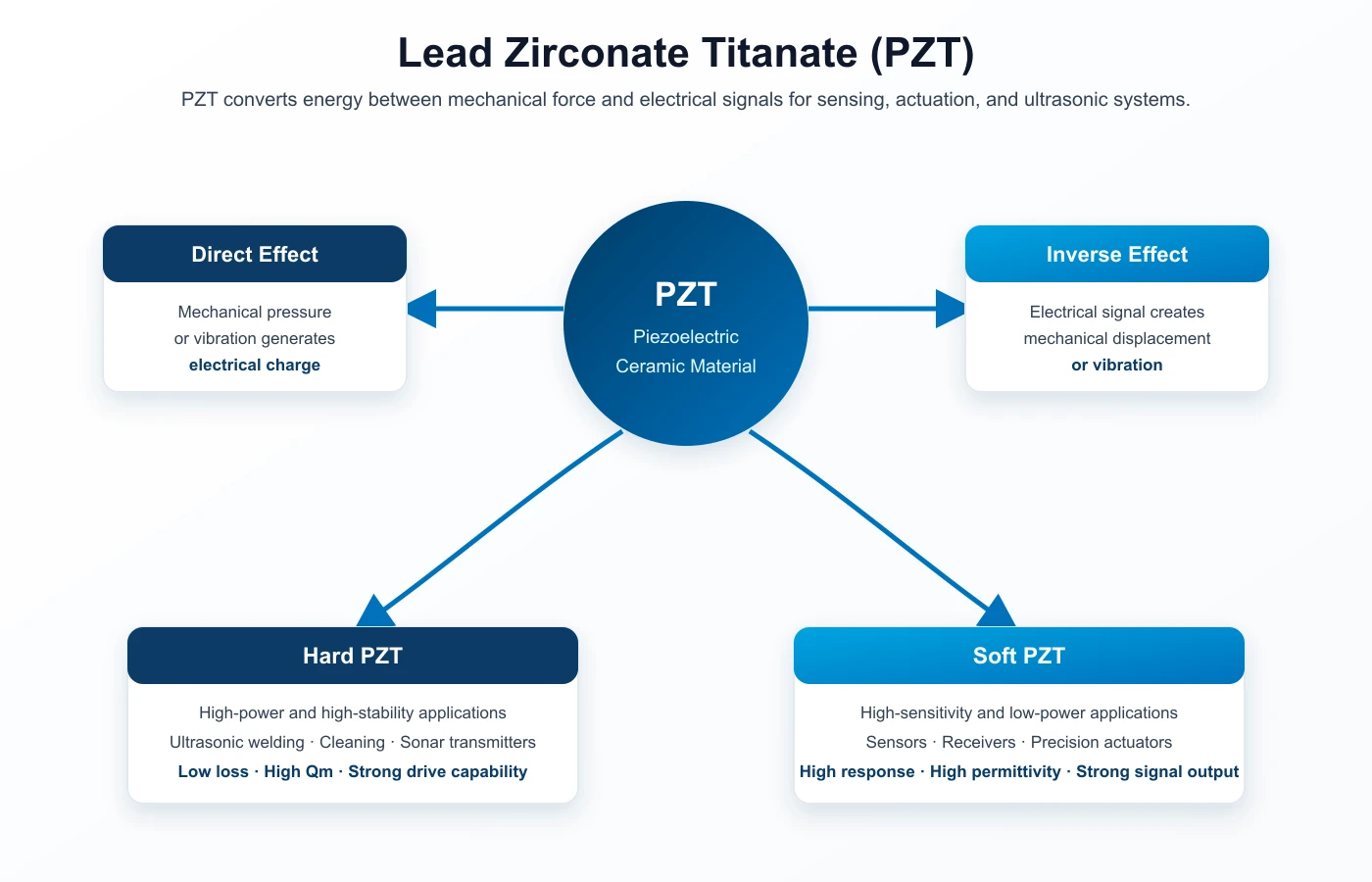
Lead Zirconate Titanate, commonly known as PZT, is one of the most widely used piezoelectric ceramic materials. It can generate an electrical charge when mechanically compressed and produce mechanical vibration or displacement when an electrical signal is applied. This dual energy-conversion capability makes PZT highly suitable for sensors, transmitters, actuators, ultrasonic transducers, and precision motion devices.
Because PZT offers strong piezoelectric performance, design flexibility, and stable manufacturing characteristics, it is widely used in industrial, medical, automotive, consumer, scientific, and underwater acoustic applications.
How PZT Works
PZT operates through two related piezoelectric effects.
The direct piezoelectric effect occurs when mechanical pressure, vibration, or deformation generates an electrical charge. This makes PZT suitable for sensing, receiving, vibration monitoring, pressure detection, and acoustic signal collection.
The inverse piezoelectric effect occurs when an applied electrical signal causes the ceramic to deform or vibrate. This makes PZT suitable for active transmitting, ultrasonic vibration, mechanical displacement, precision positioning, and actuator applications.
Because PZT can work in both directions, it is used in both passive sensing and active driving systems.
Hard PZT and Soft PZT Materials
PZT materials are commonly divided into two major categories: hard PZT and soft PZT.
Hard PZT materials are designed to withstand high levels of electrical and mechanical stress. They are especially suitable for high-voltage, high-power, and continuous-duty applications. Hard PZT materials are often selected for ultrasonic welding, ultrasonic cleaning, ultrasonic cutting, sonar transmitters, and other power ultrasonic systems.
Soft PZT materials provide higher sensitivity and permittivity. They are especially useful for sensing and low-power signal applications, where strong response and signal output are more important than high-power durability. Soft PZT materials are commonly used in receivers, sensors, low-power transducers, and precision actuators.
Selecting the right type of PZT depends on the application requirements, including power level, sensitivity, drive voltage, operating frequency, mechanical load, and environmental conditions.
PZT Shapes and Manufacturing Flexibility
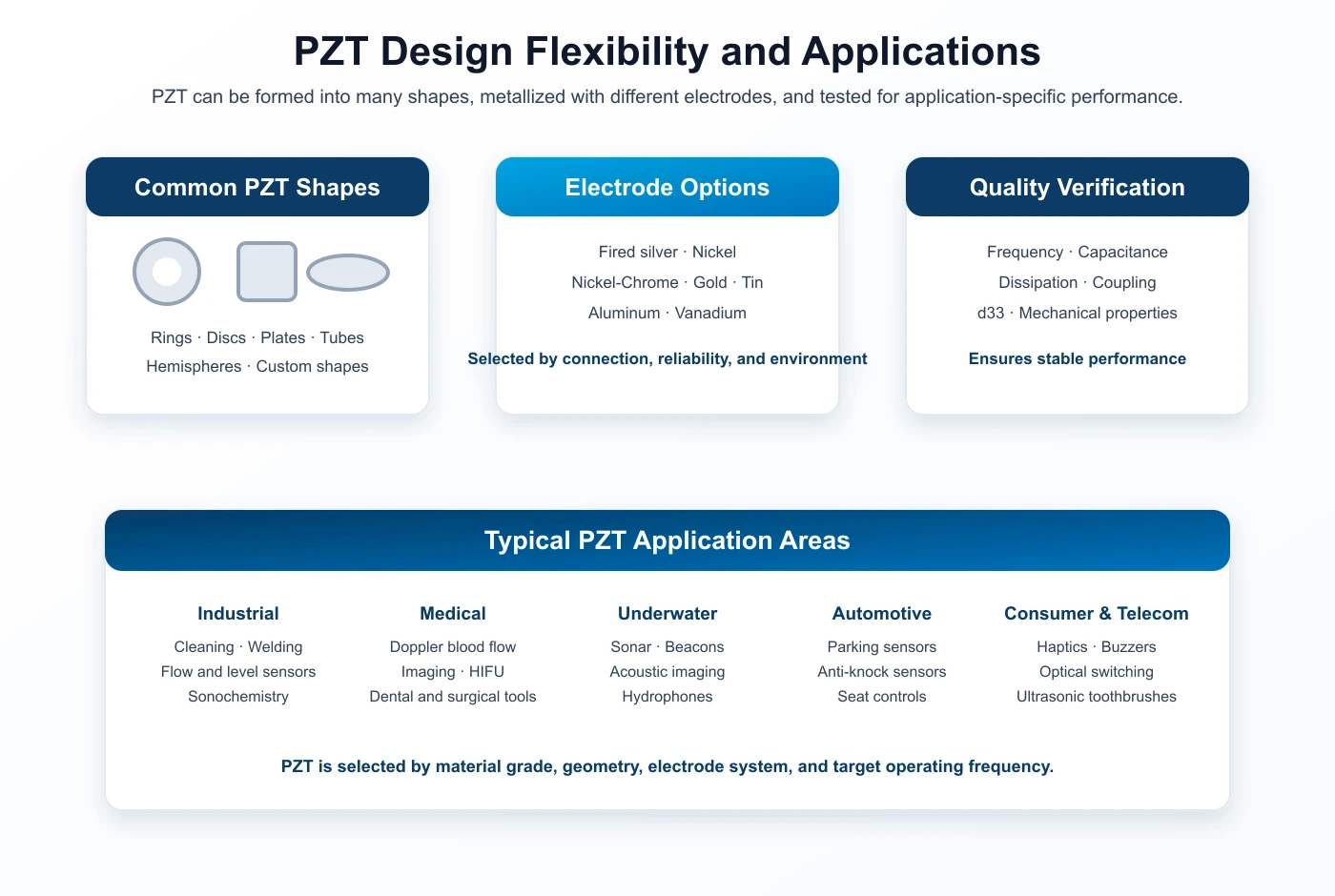
PZT is a machinable ceramic and can be manufactured with precise dimensions for a wide range of component designs. Common forms include:
- Tubes
- Rings
- Discs
- Plates
- Hemispheres
- Spheres
- Custom components
- Co-fired bimorphs
- Multilayer actuators
PZT components can range from micron-scale devices to centimeter-scale industrial elements. Depending on design requirements, PZT can be formed by pressing, extrusion, casting, machining, and other ceramic processing methods.
This flexibility allows engineers to design components for specific resonance frequencies, vibration modes, capacitance values, mechanical interfaces, and application environments.
Electrode Options
Electrodes are essential for applying electrical signals to PZT components or collecting electrical charge from them. Different electrode materials can be selected according to solderability, corrosion resistance, bonding method, operating temperature, and electrical performance.
Common electrode options include:
- Fired silver
- Electroless nickel
- Sputtered nickel-chrome
- Vacuum-deposited nickel-chrome
- Gold
- Tin
- Aluminum
- Vanadium
The right electrode design helps improve electrical connection, reliability, and long-term performance in the final device.
Typical PZT Characteristics
PZT offers a combination of properties that make it useful in many electromechanical applications:
- Wide operating frequency range, from sub-audible and audible to ultrasonic
- High output with relatively low drive levels
- Fast response at high frequency
- High sensitivity for active or passive use
- Compatibility with low-voltage and high-voltage drive circuits
- Good mechanical and acoustic coupling
- Customizable shapes, sizes, and compositions
- Strong design flexibility for specific application requirements
These characteristics make PZT a practical material choice for both precision signal devices and high-power ultrasonic systems.
Quality Testing and Performance Verification
Reliable PZT performance depends on strict material control, dimensional accuracy, and electrical testing. Each PZT component should be verified against the required specification before use in critical applications.
Common test parameters include:
- Resonance frequency
- Capacitance
- Dissipation factor
- Electromechanical coupling
- d33 piezoelectric charge constant
- Mechanical properties
- Dimensional accuracy
- Electrode quality
For ultrasonic transducers and precision devices, consistent testing helps ensure stable frequency response, reliable output, and predictable performance in production.
Typical Applications of PZT
PZT is used across a wide range of industries and technologies.
Underwater and Acoustic Systems
PZT is widely used in sonar, underwater beacons, acoustic imaging, current meters, and hydrophones. Its ability to transmit and receive acoustic energy makes it suitable for underwater exploration and measurement systems.
Aerospace and Automotive
PZT components are used in gyroscopes, accelerometers, level sensing, power seat controls, reversing and collision avoidance sensors, and anti-knock sensors. These applications benefit from fast response and compact design.
Medical Devices
Medical applications include Doppler blood flow measurement, ultrasound imaging, high-intensity focused ultrasound, ophthalmic surgical tools, dental descaling, general surgery, tissue ablation, medication delivery, hearing enhancement, and bubble detection.
Consumer Products
PZT can be found in ultrasonic toothbrushes, jewelry cleaners, contact lens cleaners, hard drive components, touchscreen feedback systems, ultra-thin speakers, cosmetic enhancement devices, buzzers, and alarms.
Industrial and Commercial Equipment
Industrial applications include flow and level sensors, ultrasonic cleaning, ultrasonic welding, intrusion alarms, fabric needle positioning, solder dispensing, machine vibration monitoring, bubble detection, and sonochemistry for improved chemical mixing.
Telecommunications and Scientific Research
PZT is used in optical switching, haptic feedback, mobile phone camera modules, nano-positioning stages, analytical tools, scanning probe microscopy, and advanced acoustic systems.
Oil Exploration
PZT components can also be used in flow and level sensing, downhole monitoring, and drill tool monitoring where compact sensing and vibration-based measurement are required.
Conclusion
Lead Zirconate Titanate (PZT) is a highly versatile piezoelectric ceramic material. Its ability to convert mechanical energy into electrical energy and electrical energy into mechanical motion makes it suitable for sensing, transmitting, actuation, and ultrasonic energy conversion.
With options for hard and soft material grades, many shapes, multiple electrode systems, and customizable compositions, PZT can be engineered for a wide range of applications. From ultrasonic cleaning and welding to medical imaging, sonar, automotive sensing, haptics, and precision motion control, PZT remains one of the most important materials in modern piezoelectric technology.

Leave A Comment