
What Is Piezoelectric?
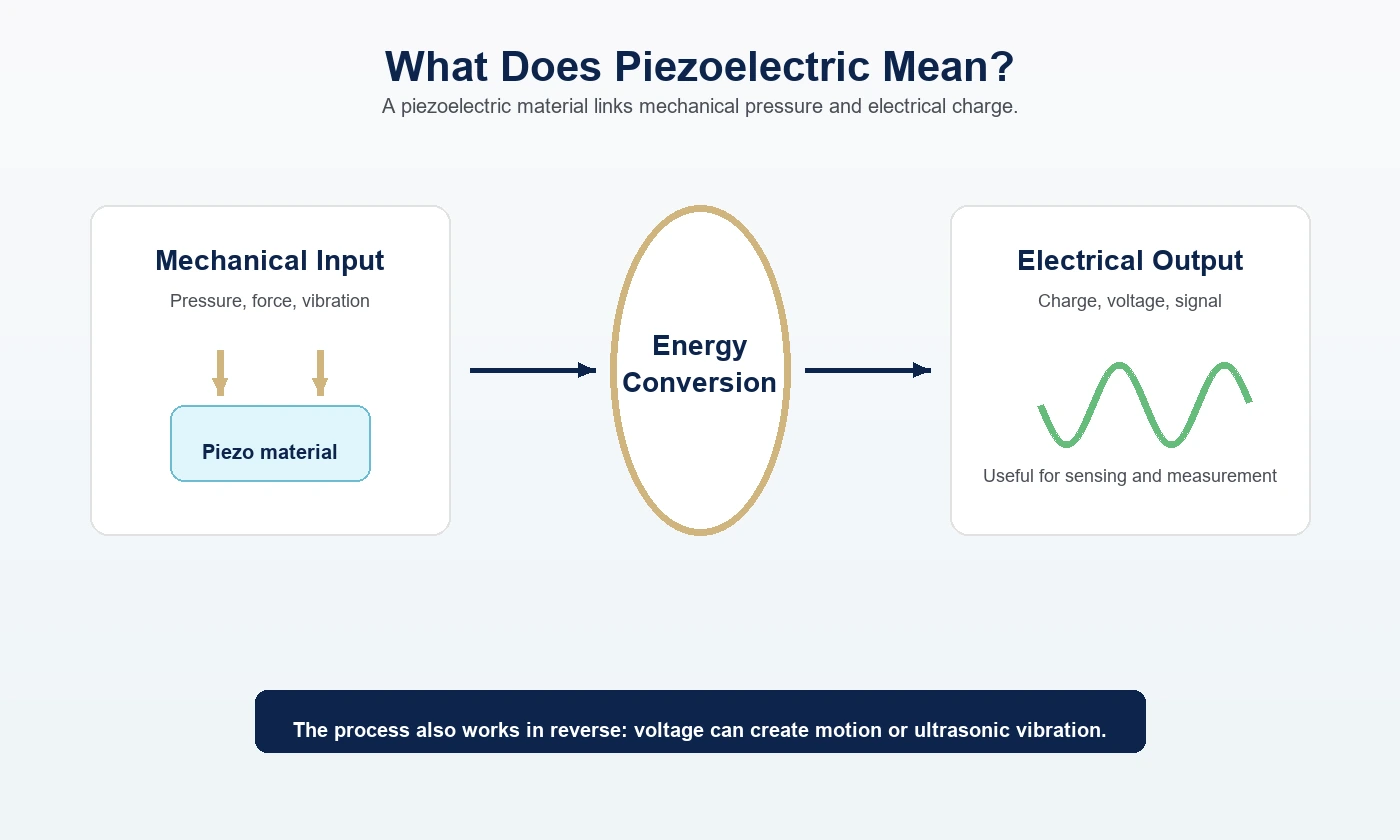
“Piezoelectric” describes a material property that allows mechanical energy and electrical energy to be converted into each other. When certain materials are pressed, compressed, bent, or vibrated, they can generate an electrical charge. When an electrical voltage is applied to the same type of material, it can change shape or vibrate. This reversible electromechanical behavior is called piezoelectricity.
The word “piezoelectric” comes from the Greek word “piezein,” meaning to press or squeeze, and the word “electric,” referring to electrical charge. In practical terms, piezoelectricity means electricity produced by pressure, and motion produced by electricity.
Piezoelectricity is found in some crystals, certain ceramics, and some biological materials such as bone and protein structures. In modern industry, piezoelectric ceramics are especially important because they can be engineered for strong performance, stable properties, and reliable mass production.
What Is Piezoelectricity?
Piezoelectricity is the electrical charge that appears in certain solid materials when mechanical stress is applied. This stress may be pressure, compression, tension, bending, vibration, impact, or acoustic wave energy.
At the microscopic level, piezoelectricity is related to the internal arrangement of positive and negative charge centers inside a material. In suitable crystal structures, these charge centers are not perfectly symmetrical. When the material is mechanically deformed, the charge centers shift slightly, creating polarization and producing an electrical signal on the material surfaces.
This process is called the direct piezoelectric effect. It is the reason piezoelectric materials can be used as sensors for pressure, force, vibration, acceleration, shock, and acoustic signals.
Piezoelectricity also works in the opposite direction. When an external electrical field is applied to a piezoelectric material, the material produces mechanical strain. It may expand, contract, bend, or vibrate. This is called the inverse piezoelectric effect. It is the reason piezoelectric ceramics can be used in actuators, buzzers, ultrasonic transducers, and precision positioning devices.
Why Piezoelectric Materials Are Useful
The most valuable feature of piezoelectric materials is their two-way energy conversion capability.
They can work as:
- Sensors, converting mechanical input into electrical signals
- Actuators, converting electrical input into mechanical movement
- Transducers, converting electrical energy into sound or ultrasonic vibration, and sometimes converting received vibration back into electrical signals
This makes piezoelectric materials useful in many fields, including industrial automation, medical devices, automotive electronics, acoustic systems, precision instruments, ultrasonic cleaning, ultrasonic welding, ultrasonic homogenization, and non-destructive testing.
Piezoelectric Ceramics and PZT
Although natural crystals such as quartz can show piezoelectric behavior, piezoelectric ceramics are widely used in industry because they can provide stronger performance and more flexible design options.
One of the most common piezoelectric ceramic materials is PZT, or lead zirconate titanate. PZT ceramics can be formulated for different application requirements. Some PZT materials are designed for high sensitivity and signal detection, while others are designed for high-power ultrasonic operation, low loss, high mechanical quality factor, and stable resonance.
Piezoelectric ceramic elements can be made in many forms, such as:
- Discs
- Rings
- Plates
- Tubes
- Stacks
- Custom shapes
This design flexibility allows piezoelectric ceramics to be used in compact sensors, power ultrasonic transducers, medical devices, acoustic components, and precision control systems.
Polarization and Poling
In many piezoelectric ceramics, the internal electric dipoles must be aligned before the material can show strong piezoelectric performance. This alignment process is called poling.
During poling, a strong electric field is applied to the ceramic, often at an elevated temperature. This helps align many of the internal domains in a preferred direction. After cooling and removing the electric field, the ceramic retains a useful polarization state.
Once poled, the ceramic can generate electrical charge when stressed and can deform when voltage is applied. The quality of the poling process affects sensitivity, stability, capacitance, resonance behavior, and final component performance.
Generating Voltage from Mechanical Stress
When a poled piezoelectric ceramic element is fitted with electrodes, mechanical stress can generate a measurable voltage. For example, if a ceramic disc is compressed or vibrated, charge appears on its electrode surfaces. The signal can then be collected by wires and measured by a circuit.
The actual voltage depends on many factors, including:
- Material formulation
- Ceramic size and shape
- Electrode area
- Direction of applied force
- Mechanical stress level
- Capacitance
- Load resistance and circuit design
- Frequency of vibration
In sensor applications, the goal is usually to obtain a clean and repeatable signal. In power applications, the focus is often on efficient vibration generation, stable resonance, and low heat generation.
Applications of Piezoelectric Technology
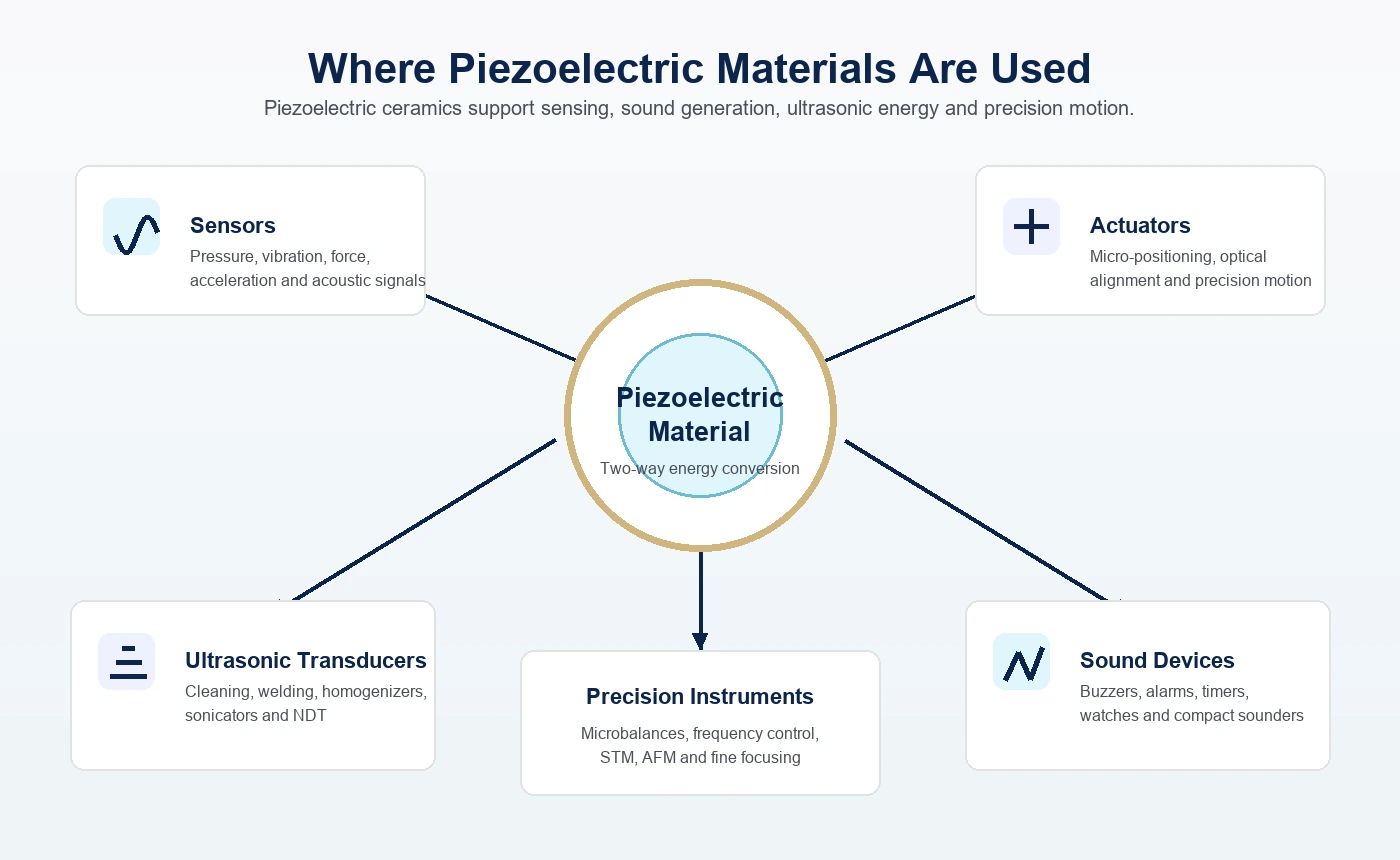
Piezoelectric technology is used in a wide range of products and systems.
In sensors, piezoelectric materials detect pressure, vibration, acceleration, force, impact, and acoustic signals. They are used in machinery monitoring, automotive knock sensors, structural health monitoring, ultrasonic receivers, and precision measurement equipment.
In sound devices, piezoelectric ceramics are used in buzzers, alarms, timers, watches, and compact electronic sounders. Applying voltage causes the ceramic to vibrate and produce sound.
In ultrasonic transducers, piezoelectric ceramics convert electrical power into ultrasonic mechanical vibration. These transducers are used in ultrasonic cleaning, ultrasonic welding, ultrasonic cutting, ultrasonic homogenizers, sonicators, dispersion systems, emulsification systems, and laboratory sample processing.
In precision motion systems, piezoelectric actuators provide very small and accurate movements for optical adjustment, micro-positioning, scanning probe microscopy, and advanced scientific instruments.
Why Piezoelectricity Matters in Ultrasonic Systems
Ultrasonic systems rely heavily on the inverse piezoelectric effect. The ultrasonic generator supplies an alternating electrical signal to the piezo ceramic stack. The ceramic vibrates at high frequency, and the transducer structure transfers that vibration into a horn, probe, tank, liquid, or other working medium.
For ultrasonic homogenizers, the transducer must deliver stable vibration into the probe so that cavitation and micro-mechanical effects can process the liquid sample. For ultrasonic cleaning, the transducer must transfer vibration into the cleaning tank or liquid to create cavitation. For ultrasonic welding and cutting, the transducer must provide stable high-frequency mechanical energy to the tool.
This is why piezoelectric ceramic material selection is critical. The ceramic affects power output, heat generation, resonance stability, amplitude, efficiency, and service life.
Piezoelectric means the ability of a material to convert mechanical stress into electrical charge and electrical voltage into mechanical movement. This reversible conversion is the foundation of piezoelectric sensors, actuators, buzzers, ultrasonic transducers, and many precision instruments.
For industrial ultrasonic equipment and piezo ceramic components, piezoelectricity is the key technology that enables efficient vibration generation, accurate signal detection, and reliable electromechanical performance.
By selecting the right piezoelectric ceramic material and component design, manufacturers can improve sensitivity, power efficiency, stability, and long-term reliability across a wide range of applications.

Leave A Comment