
What Is Ultrasonic Shadowing?
Ultrasonic cleaning is widely used to remove contaminants from precision components, complex parts, and delicate assemblies. By combining high-frequency ultrasonic energy with a suitable cleaning liquid, the process creates microscopic cavitation bubbles that rapidly form and collapse on the surface of immersed parts. This cavitation action helps loosen and remove oil, dust, polishing compounds, residues, and other contaminants from metals, plastics, glass, ceramics, rubber, and many other materials.
One of the major advantages of ultrasonic cleaning is its ability to reach areas that are difficult to clean manually, including blind holes, grooves, cracks, recesses, and internal surfaces. However, even an effective ultrasonic cleaning process can be affected by improper part placement. One common issue is known as ultrasonic shadowing.
What Is Ultrasonic Shadowing?
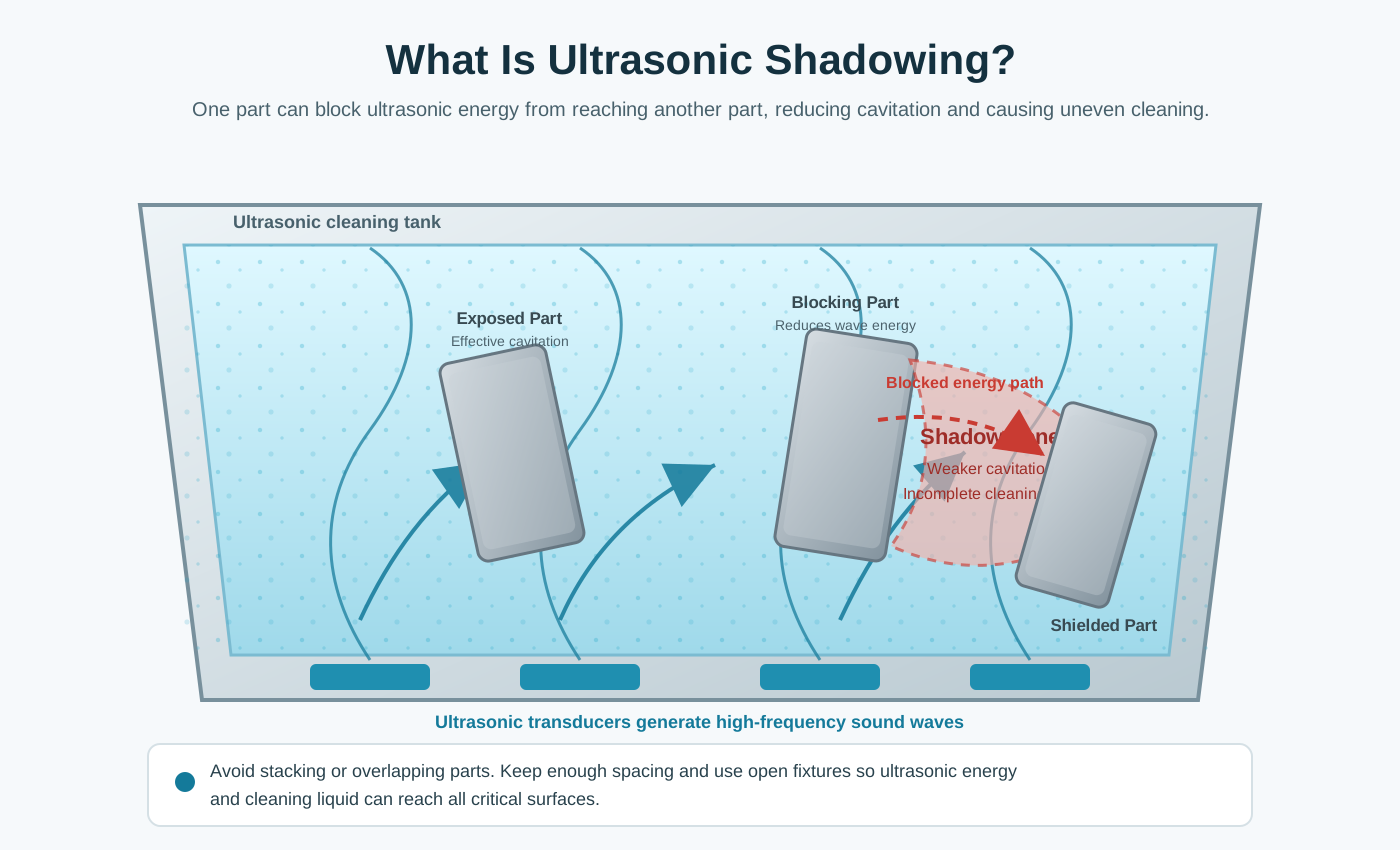
Ultrasonic shadowing occurs when one part blocks or reduces the ultrasonic energy reaching another part in the cleaning tank. When this happens, the shielded area may receive less cavitation activity, resulting in uneven or incomplete cleaning.
Unlike a visual shadow created by sunlight, an ultrasonic shadow does not have a sharp or clearly defined shape. Ultrasonic energy travels through liquid in a more distributed way, so shadowing is often gradual and difficult to predict. Some surfaces may still receive partial ultrasonic energy, while others may receive too little energy for effective cleaning.
Why Does Ultrasonic Shadowing Happen?
Ultrasonic shadowing is usually caused by poor loading, stacking, or fixture design. When parts are placed too closely together, overlapped, or positioned in a way that blocks the sound path, ultrasonic waves may not reach all surfaces with equal strength.
The effect can become more noticeable when multiple thin parts are placed in layers. A single thin metal plate may have little impact on ultrasonic transmission, but several plates arranged close together can reduce energy transfer and create reflections between surfaces. This can lower cleaning efficiency in certain areas.
How Ultrasonic Shadowing Affects Cleaning Results
When ultrasonic shadowing occurs, some areas of the parts may be cleaned effectively while others remain contaminated. This can lead to:
- Uneven cleaning performance
- Residual oil, particles, or polishing compound
- Poor cleaning of holes, recesses, or hidden surfaces
- Inconsistent results between batches
- Longer cleaning cycles or repeated cleaning
- Reduced process reliability in precision applications
For industries such as medical devices, electronics, automotive parts, aerospace components, and precision manufacturing, avoiding ultrasonic shadowing is important for maintaining consistent cleaning quality.
How to Identify Ultrasonic Shadowing
If parts are not being cleaned consistently, ultrasonic shadowing may be one possible cause. A simple way to evaluate this is to clean a single part separately in the tank under the same process conditions.
If the single part is cleaned effectively, but a full basket or rack of parts shows poor results, the issue may be related to part arrangement, fixture design, or ultrasonic energy distribution rather than equipment failure.
How to Reduce Ultrasonic Shadowing
To minimize ultrasonic shadowing, parts should be positioned so that ultrasonic energy can reach as many surfaces as possible. Good loading and fixture design are essential for stable cleaning performance.
Recommended practices include:
- Avoid stacking or overlapping parts
- Keep enough spacing between components
- Use baskets or fixtures that allow good liquid flow
- Position complex surfaces toward the ultrasonic energy field
- Rotate or reposition parts when necessary
- Avoid overloading the cleaning tank
- Use proper fixtures for delicate or precision components
- Validate cleaning results with actual production parts
For parts with complex geometries, customized fixtures may be required to ensure that critical surfaces receive sufficient ultrasonic energy.
Why Proper Fixture Design Matters
The fixture or basket used in ultrasonic cleaning should support the parts securely without blocking too much ultrasonic energy. Poorly designed fixtures can reduce cavitation intensity and create shadowed areas. A well-designed fixture helps improve cleaning uniformity, protects the parts from damage, and supports repeatable batch processing.
For high-value or precision components, fixture design should be considered an important part of the ultrasonic cleaning process, not just an accessory.
Summary
Ultrasonic shadowing is an important factor that can affect cleaning performance in ultrasonic cleaning systems. It occurs when parts, baskets, or fixtures block ultrasonic energy and reduce cavitation activity in certain areas.
By using proper part spacing, suitable baskets, optimized fixtures, and correct loading methods, manufacturers can reduce shadowing and achieve more consistent cleaning results. For demanding industrial applications, careful process design is essential to ensure that ultrasonic cleaning delivers its full advantages: fast, thorough, and repeatable cleaning for complex parts.

Leave A Comment